

ERPs store financial data but don't execute accounting work. Finance teams still face manual reconciliations, consolidations, and close bottlenecks despite having enterprise systems. The execution gap persists because recording transactions differs from performing operational work.
Most Controllers can describe their enterprise system's capabilities in detail. They know which reports it generates, how consolidation modules work, and where transaction data lives. What surprises them is discovering that months after implementation, their teams still export data to spreadsheets for actual reconciliation work, manually match intercompany transactions across entities, and coordinate consolidations outside the system entirely.
The assumption was straightforward: implement a robust financial platform, and operational accounting work becomes automated. Reality delivers something different. The system captures every transaction flawlessly and organizes data beautifully, yet someone still performs the reconciliations, prepares the elimination entries, and executes the close manually. The platform records but doesn't execute.
This post explores what enterprise systems actually do versus what finance teams need to complete operational work, drawing from recent conversations with finance leaders about the persistent execution gap. Understanding this distinction explains why transaction recording excellence doesn't eliminate manual accounting work and reveals where Agentic Performance Management introduces the missing execution layer.
Nominal ran a webinar with Katherine Mejia, Account Executive, and Stephanie Mansueto, VP of Marketing, on The Finance Operations Layer Your ERP Wasn't Built For. Click here to watch the full webinar or keep reading to see the highlights of it.
Why ERPs Still Leave Finance Work Manual
Financial platforms function as repositories for business transactions. When a sale completes, an invoice generates, or payroll processes, the system captures these events and files them according to accounting rules. Think of it as a sophisticated filing cabinet that knows exactly where each piece of financial information belongs.
This recording function works remarkably well. The platform maintains integrity across accounts, ensures debits equal credits, and produces reports showing what happened financially during any period. For organizations with straightforward structures, this capability often meets their needs entirely.
Complexity reveals limitations. When finance teams need to match cash receipts against outstanding invoices across multiple bank accounts, the system provides the data, but someone must perform the matching. When subsidiaries in different countries transact with each other, the platform stores both sides of the transaction, but an accountant must identify the pair, verify amounts align, and prepare entries that eliminate the internal activity from consolidated reports.
The distinction matters because storing information and acting on information require fundamentally different capabilities. A library catalogs books superbly but doesn't read them, analyze them, or write summaries. Financial platforms catalog transactions superbly but don't reconcile them, investigate discrepancies, or resolve exceptions.
The cost isn't just in dollars. It's also burnout, turnover, and loss of trust in the numbers.
If the business grows 30%, finance headcount grows 30%. That's not a strategy. That's a tax on growth.
What Finance Teams Actually Need: An Execution Layer
Finance operations require three distinct capabilities working together. Enterprise systems evolved to solve a data organization problem. Before these platforms existed, companies maintained separate ledgers for different functions, struggled to consolidate information, and couldn't easily produce comprehensive financial reports. The innovation was creating unified databases where all business activity lived in one place under consistent rules.
This architecture created clear functional layers:
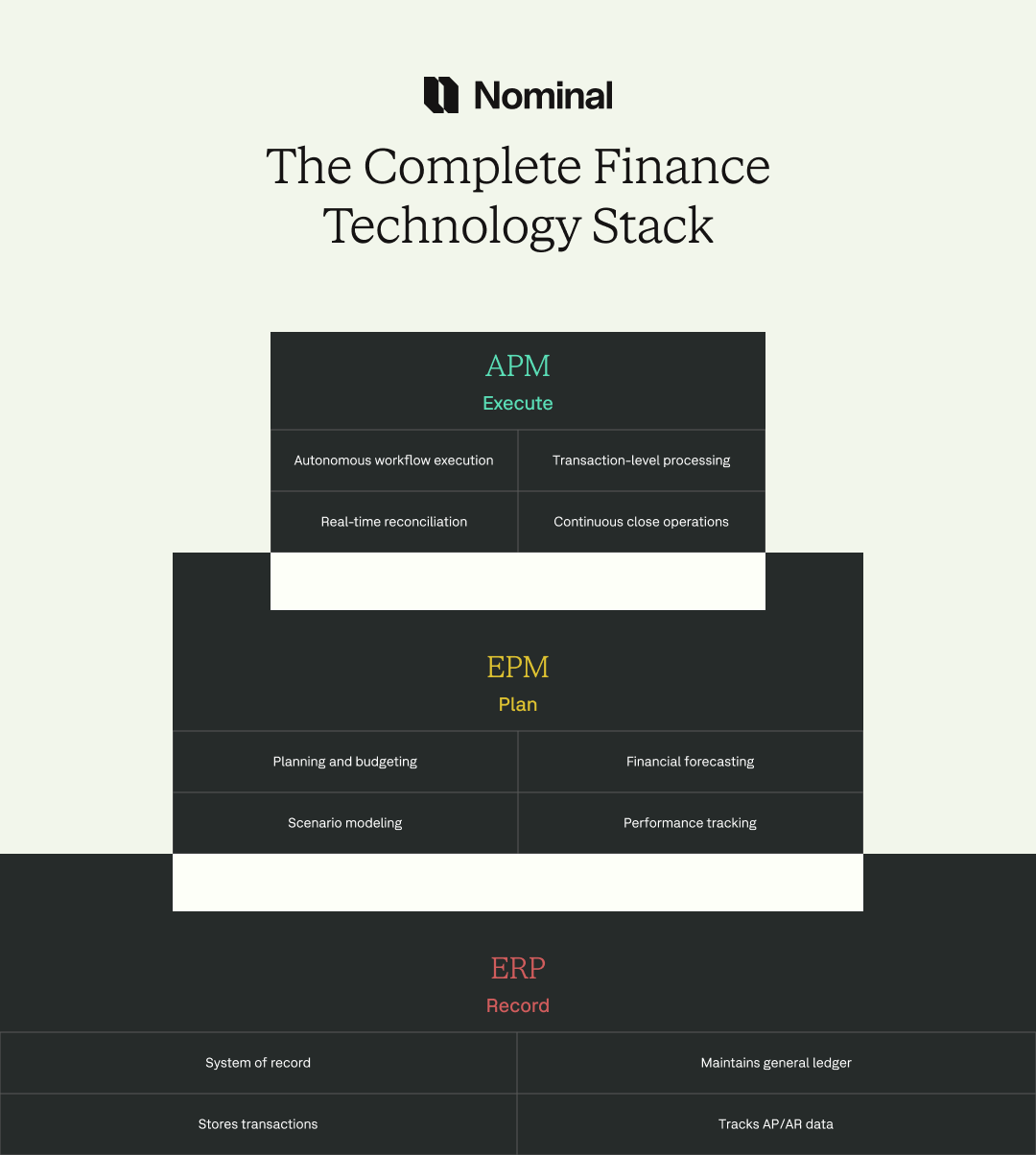
ERP: System of Record
The enterprise platform captures and organizes transaction data with compliance and accuracy. It maintains the authoritative source for all financial information.
EPM: Planning and Forecasting
Enterprise Performance Management handles budgeting, forecasting, and strategic planning that guides business decisions.
APM: Execution Layer
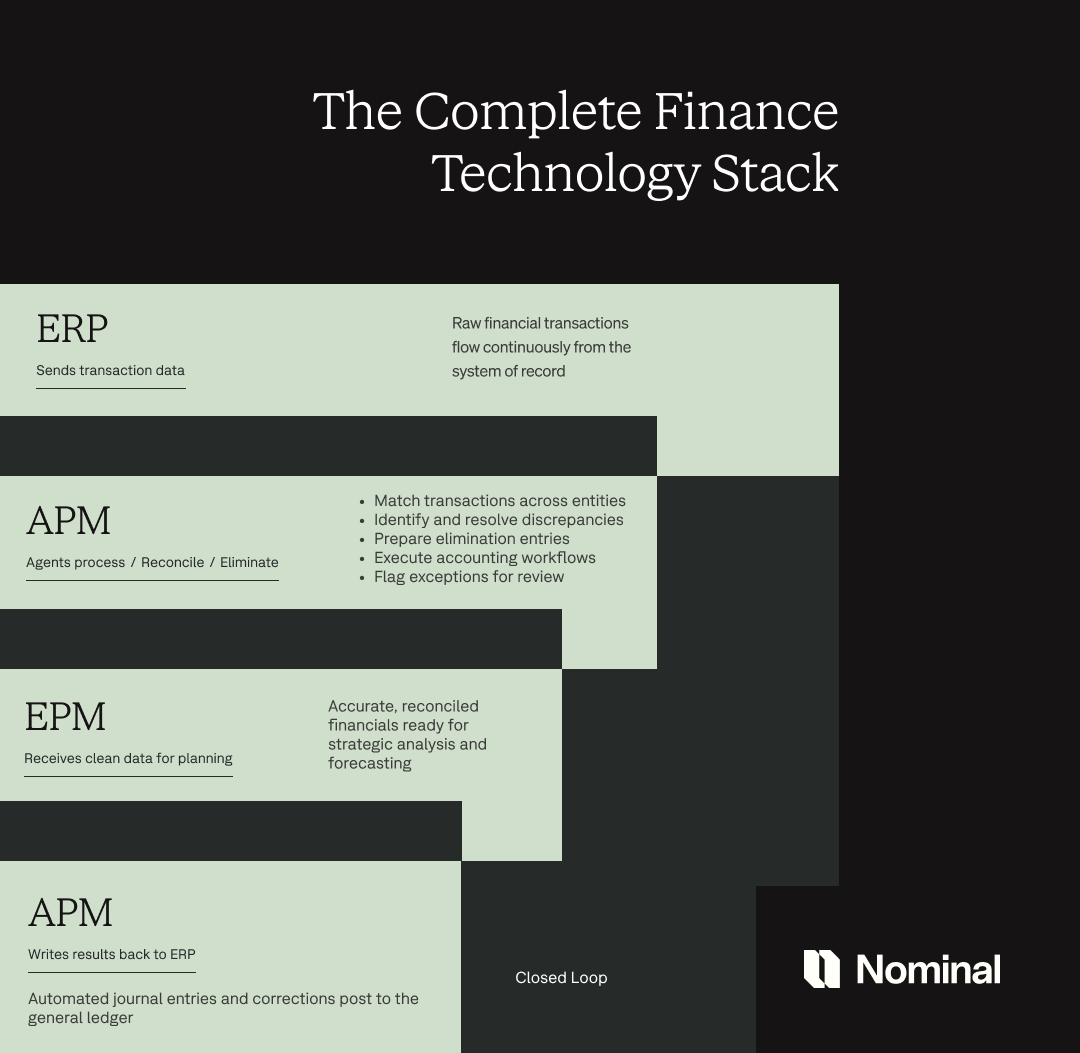
Agentic Performance Management introduces the missing piece. Intelligent agents that execute reconciliations, consolidations, and close processes autonomously. APM doesn't replace the ERP or EPM. It handles operational accounting work that currently requires manual coordination.
The platform remains the source of truth. Agents pull information, perform operational work, and write results back through proper channels. The financial system continues functioning as the system of record while agents handle the execution gap that has always required manual work.
APM doesn't replace your ERP. It makes it useful.
Recommended read: The ERP Accounting Gap: What Mid-Market Finance Teams Need to Know
What AI Agents Do Differently (With Real Examples)
Agentic Performance Management deploys intelligent agents that own complete workflows and execute them independently. These capabilities demonstrate how autonomous execution transforms specific workflows that traditionally consume days of manual effort.
Transaction Patrol: Continuous Monitoring
Transaction Patrol monitors activity continuously, flagging unusual patterns in real time. When vendor invoices hit accounts payable at amounts significantly above normal, the agent escalates immediately rather than waiting for month-end review. Finance teams investigate genuine anomalies instead of manually reviewing every transaction.
Reconciliations: Agents Match, Humans Review Exceptions
Reconciliation agents match bank transactions against outstanding items as they occur. The system identifies pairs that should offset, resolves standard timing differences automatically, and escalates only when discrepancies exceed configured thresholds. Organizations report reconciliation time dropping from days to hours as agents handle matching continuously while finance teams review only exceptions.
Intercompany Eliminations: Automatic Identification and Matching
Intercompany Elimination agents identify related-party transactions across entities, match them automatically, and prepare required elimination entries without manual coordination. When subsidiary A records a sale to subsidiary B, agents recognize the pair, handle currency translation if needed, and produce consolidation-ready results. This eliminates the time-consuming manual process of extracting transaction lists, using spreadsheet functions to identify potential matches, and investigating why amounts differ.
Flux Analysis: Agents Detect and Explain Variances
Rather than calculating variances manually, Flux Analysis agents detect significant period-over-period changes and surface explanations with context. The system examines transaction details, identifies patterns causing fluctuations, and presents analysis alongside the numbers. Analysts focus on decision-making rather than data gathering.
These agents don't follow rigid scripts that break when conditions change. They adapt to each organization's specific circumstances, learn from patterns in transaction data, and apply contextual logic when handling exceptions. An agent managing cash reconciliation learns which timing differences typically resolve themselves, which vendors consistently create matching challenges, and which scenarios genuinely require human review.
From Oversight to Impact: How Teams Are Scaling with Nominal
Organizations running operations with autonomous execution capability experience fundamental differences in how finance functions. The changes extend beyond faster processes into what finance teams can accomplish and how they create value.
Close Time Drops from 10 to 15 Days to 3 or Fewer
Close cycles compress dramatically because work happens continuously rather than concentrating at period end. Reconciliations stay current throughout the month. Consolidation maintains updated results as transactions occur. Finance teams use period-end for review and final approval rather than days of frantic activity performing operational tasks under deadline pressure.
Teams Move from Doing the Work to Supervising the Work
Finance professionals focus on different work entirely. Controllers design and optimize processes that agents execute rather than managing task completion. Analysts investigate meaningful variances rather than calculating them manually. Teams apply judgment and expertise to decisions and strategy rather than consuming capacity on repetitive operational execution.
Non-Linear Scaling Replaces Headcount Growth
Growth no longer creates proportional staffing requirements. When transaction volume increases, agents scale execution automatically. Adding subsidiaries doesn't trigger hiring plans because agents extend their work across new entities without additional resources. Finance operations support business expansion rather than constraining it through capacity limitations.
Mid-market organizations experience this transformation most acutely. A company managing subsidiaries across several states or countries generates internal transactions constantly. One subsidiary sells products to another, corporation allocates shared service costs, and entities loan money between themselves.
Finance teams traditionally spent days coordinating data that already existed in their system. With autonomous execution, agents handle consolidation workflows while finance teams govern by reviewing results rather than creating them.
Helpful resource: How to Scale Finance Operations Without Adding Headcount: Data-Driven Insights from 50 Million Transactions
Why This Matters Now
Boards are pushing for efficient growth. The old way of scaling via headcount is breaking. AI is now mature and secure enough for core finance workflows. Agents aren't co-pilots. They do the work, with finance team oversight.
Three forces converge to make autonomous execution critical for finance organizations. First, competitive pressure demands operations that scale without proportional cost increases. Traditional approaches of hiring accountants to match complexity growth break at scale.
Second, AI technology matured to handle core finance workflows with security and accuracy that satisfy audit requirements. Early automation attempts required rigid rules that broke when conditions changed. Modern agents adapt to organizational specifics, learn from transaction patterns, and apply contextual logic when handling exceptions.
Third, the competitive gap widens between organizations operating with execution capability versus those constrained by manual coordination. Finance teams running autonomous agents close faster, scale gracefully, and apply expertise strategically. Those still exporting data to spreadsheets fall further behind as complexity increases.
The transformation resembles what occurred in other business functions when automation matured from assisting humans to autonomous execution. Manufacturing teams stopped focusing on machine operation and concentrated on process optimization. Logistics teams moved from coordinating individual shipments to designing distribution networks. Finance teams can similarly evolve from executing accounting tasks to architecting financial operations.
Book a live demo to see how agentic automation could cut your close time in half without replacing your ERP. Discover how Nominal's Agentic Performance Management creates the execution layer that transforms finance operations from coordination bottleneck to strategic advantage.