

Business Central users managing 5-10+ entities face compounding manual work that the ERP can't automate. Agentic Performance Management breaks the scaling wall by executing intercompany reconciliation, consolidation, and close workflows autonomously.
Business Central was the perfect fit when your company had one entity, maybe two. Month-end close took three days. Reporting was straightforward. The finance team of four people had everything under control.
Then growth happened. An acquisition here, a new subsidiary there. Suddenly, you're managing eight entities, then twelve. Month-end close now takes two weeks. The same four-person team is drowning in login credentials, Excel exports, and manual consolidation work. You're hiring, but new entities are coming faster than new accountants.
This isn't a D365 BC problem. The platform does exactly what it was designed to do: maintain accurate financial records for each entity. The issue is that the ERP wasn't built to execute the operational complexity that comes with rapid multi-entity growth. Finance teams hit what's commonly called the scaling wall, where adding entities creates exponentially more work, not linearly more.
The good news? The scaling wall isn't inevitable. Agentic Performance Management introduces an execution layer that handles the manual work Business Central can't automate.
The Business Central Scaling Wall
As companies grow from single-entity to multi-entity operations, finance teams hit three compounding problems that the ERP simply wasn't designed to solve.
The Login Marathon
Finance teams managing multiple entities know this pain intimately. Month-end close means logging into Entity A, exporting data, logging out, logging into Entity B, exporting data, logging out, and repeating this process across ten or more company files. What took three days with three entities now takes twelve days with ten entities because the work compounds.
Each entity operates as its own island inside D365 BC. Consolidation requires manual coordination across these islands. Senior accountants spend hours just navigating between company files to gather the data needed for a consolidated view. The login marathon isn't just tedious; it's a structural bottleneck that slows every workflow.
The Manual Consolidation Trap
Native consolidation features exist, but the reality is more complex. True consolidation often requires setting up a separate "consolidation company" within the system. Data synchronization between entities is rarely live, which means finance teams are constantly running manual updates to ensure they're working with current information.
Intercompany eliminations present an even bigger challenge. While D365 BC has tools for handling intercompany transactions, they're too rigid to accommodate real-world messiness. Timing differences between when Entity A records a transaction and when Entity B records the same transaction create mismatches.
Currency fluctuations introduce variances that the system can't automatically reconcile. Coding discrepancies, where one entity uses a different account code than another, require manual investigation and adjustment.
The result? Finance teams export intercompany data to Excel, build macros to match transactions, identify discrepancies, prepare adjusting entries, and then import corrections back into the system. The ERP becomes a sophisticated filing cabinet, while Excel becomes the actual execution engine.
The Reporting Bottleneck
Reporting capabilities are powerful but inflexible. Modifying a report to add a column, adjust row definitions, or change grouping logic isn't something finance teams can do on their own. These changes require developer intervention or working with "Analysis Views," which are complex, brittle, and prone to breaking when underlying data structures change.
Simple reporting requests turn into IT tickets with multi-week turnaround times. During closing periods, when finance teams need to pivot quickly based on what the numbers are showing, this bottleneck becomes critical. Teams resort to exporting raw data to Excel and building their own reports manually, defeating the purpose of having an ERP in the first place.
You might also like: Multi-Entity Reporting: How to Consolidate Financials Across Entities Without Spreadsheets
The Impossible Triangle: Speed, Accuracy, Cost
Mid-market finance teams face a constraint that enterprise teams can throw money at. When managing multi-entity operations, finance leaders are forced to choose between three critical outcomes: speed, accuracy, and cost. Traditional approaches only allow you to pick two.
The Three Choices

Fast and Accurate = Expensive
Hire more people. Add senior accountants who can handle the complexity, bring in specialists for intercompany reconciliation, expand the team proportionally as entity count grows. This approach works, but it's expensive. For mid-market companies operating on tight budgets, scaling headcount linearly with entity growth isn't financially viable.
Fast and Cheap = Inaccurate
Rush through the close process with your existing small team, skip detailed reconciliation work, and hope nothing critical slips through. This approach is risky. Audit issues, regulatory problems, and financial misstatements become inevitable when accuracy is sacrificed for speed.
Accurate and Cheap = Slow
Keep your small team, maintain rigorous standards, but reconcile yourself to extended close timelines. This approach satisfies compliance requirements but creates strategic blindness. By the time consolidated financials are ready, they're too old to inform real-time business decisions.
Why Mid-Market Can't Afford to Choose
The mid-market reality is that companies can't afford to pick any two:
- Speed matters because business moves fast
- Accuracy matters because compliance isn't optional
- Cost control matters because margins are tight
The traditional model forces an impossible choice.
The M&A Multiplier
M&A activity compounds this problem exponentially. Companies acquiring five to seven entities per year can't hire five to seven new accountants each year to maintain the same service level. Accounting teams at organizations like isolved face this exact scenario: entity count growing rapidly while headcount remains flat. The scaling wall becomes a crisis when the same four-person team that managed three entities is suddenly responsible for fifteen.
How Agentic Performance Management Breaks Through
Agentic Performance Management introduces a fourth option that traditional finance automation couldn't deliver: autonomous execution that handles the manual work the ERP can't. APM doesn't replace the system. It augments it by adding an execution layer that performs the labor that financial teams currently do in spreadsheets.
Multi-Entity Orchestration
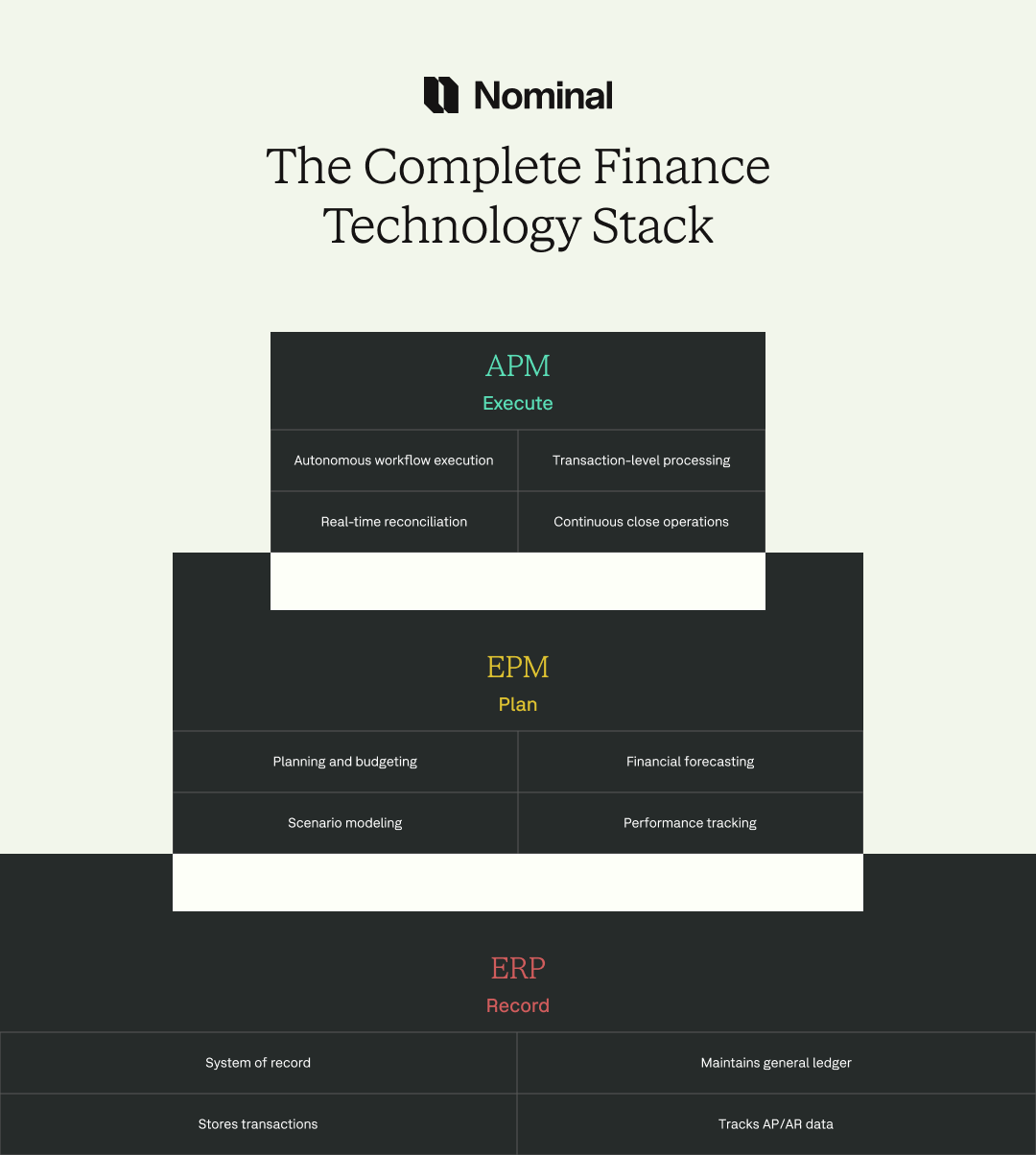
APM sits above the ERP, connecting to all entities simultaneously through a single interface. Finance teams no longer log in and out of different company files to perform cross-entity workflows. Reconciliation, consolidation, and reporting happen in one environment that maintains live connections to every instance.
This architectural approach eliminates the login marathon entirely. Month-end close tasks that required touching twelve separate company files now happen through one unified workspace. The time savings are dramatic, but the real value is operational: finance teams can see the full picture without manual aggregation.
Explore more on this topic: The ERP Accounting Gap: What Mid-Market Finance Teams Need to Know
Automated Intercompany Reconciliation
Intercompany transactions create the most manual work for multi-entity finance teams. APM deploys Resolution Agents that detect and reconcile transactions across ledgers automatically. These agents handle the scenarios that D365 BC records but can't resolve.
- Timing differences? Resolution Agents match transactions even when Entity A records a sale on March 31 and Entity B records the corresponding purchase on April 1.
- Currency fluctuations? Agents calculate and post the variance adjustments automatically when exchange rates shift between invoice date and payment date.
- Coding discrepancies? Agents flag mismatches and prepare the correcting entries without human intervention.
The Excel export, macro matching, manual adjustment, and import workflow disappear. Accountants review and approve reconciliations instead of building them from scratch. Companies managing ten or more entities report cutting intercompany reconciliation time from days to hours.
Continuous Close Operations
Traditional month-end close is a sprint. Finance teams wait until the last day of the month, then spend two weeks cleaning up errors, investigating variances, and preparing adjustments. APM enables a different model: continuous close.
Transaction Patrol monitors the General Ledger across all entities daily. As transactions post, agents flag misclassifications, coding errors, and anomalies in real time. Resolution Agents prepare correcting entries automatically throughout the month rather than waiting for month-end. By the time the calendar flips, the books are already clean.
This shift moves finance teams from reactive cleanup to proactive maintenance. Small teams maintain accuracy standards without adding headcount because the volume of month-end work decreases dramatically. Close timelines compress from weeks to days because there's less remediation work required.
The Augmentation Model
Business Central remains the system of record. All financial data still lives in D365 BC, compliance requirements are still met through the ERP, and audit trails remain intact. APM doesn't replace this foundation. It becomes the autonomous workforce that executes on top of it.
Implementation happens in weeks, not months. There's no data migration, no rip-and-replace risk, and no disruption to existing workflows. Finance teams continue using their ERP exactly as they do today. APM layers on top, handling the manual execution work that was never designed to be automated.
Helpful resource: Beyond the ERP: Modernizing Bank Reconciliations for Workday Finance Teams
Business Central holds your financial data beautifully. The platform maintains accurate records, ensures compliance, and provides the structured foundation every finance team needs. But holding data and executing workflows are fundamentally different capabilities.
The scaling wall is real. As entity count grows, the manual work of logging into separate company files, exporting data to Excel, matching intercompany transactions, and preparing consolidations compounds exponentially. Mid-market finance teams hit a breaking point where growth becomes operationally unsustainable without proportional headcount increases.
Agentic Performance Management breaks the impossible triangle. Finance teams can scale entity count without scaling headcount by deploying autonomous agents that execute the manual work the ERP can't automate. Speed, accuracy, and cost control become achievable simultaneously instead of competing priorities.
Ready to see how mid-market finance teams are managing 10+ entities with 3-person teams? Book a demo to explore how APM augments your system with autonomous execution capabilities.