


A financial audit with AI replaces manual reconciliations, fragmented documentation, and reactive close cycles with intelligent automation. Accounting teams that embed AI agents into their workflows close faster, surface issues earlier, and stay audit-ready year-round without adding headcount.
For most accounting teams, a financial audit with AI is still not the reality. The reality is controlled chaos: requests pile up, spreadsheets multiply, and documentation that should be ready somehow never quite is. Senior professionals who should be reviewing and analyzing spend their days chasing down files and reconciling ledgers by hand.
The frustration is understandable. But the assumption behind it, that this is simply how reviews work, is worth challenging.
The teams moving fastest through year-end cycles today are not necessarily larger or better resourced. They are better organized, and increasingly, they are supported by AI agents that handle the operational load so controllers and their teams can focus on what actually moves the business forward.
This shift is not about replacing expertise. It is about embedding it into systems that scale. When institutional knowledge lives inside intelligent agents instead of individual spreadsheets, the accounting function stops being the bottleneck and starts being the strategic driver it was always meant to be.
Why Financial Audits Still Feel Like Fire Drills
The challenge is rarely about competence. Most accounting teams know exactly what needs to be done. The problem is the infrastructure they are working with.
Fragmented documentation is one of the most common obstacles. Supporting schedules live in different folders, owned by different people, with no consistent naming convention or version control. When a reviewer submits a prepared-by-client request, the response involves a scramble across inboxes, shared drives, and legacy systems.
Manual reconciliations compound the pressure. Matching intercompany transactions, reconciling bank balances, validating fixed asset schedules, and tracing entries across multiple entities takes time that most teams simply do not have during close. When these tasks are done manually, they are also prone to the kind of human error that surfaces at the worst possible moment: during fieldwork.
Perhaps the most underappreciated risk is the concentration of institutional knowledge. When one or two people understand how a reconciliation works, or know where a particular adjustment is documented, the team is one resignation or sick day away from a material gap in readiness. That knowledge belongs in the system, not in someone's memory.
What Reviewers Are Actually Looking For
Understanding what external reviewers prioritize helps accountants prepare more precisely. Independent reviewers focus on three things above all: completeness, consistency, and traceability.
Completeness means every balance sheet account is supported. Consistency means reconciliations follow the same methodology period over period. Traceability means any figure in the financial statements can be followed back to a source document without ambiguity.
Teams that build their workflows around these three principles are better prepared before reviewers arrive, and better equipped to respond when questions come in during fieldwork.
How AI Changes the Financial Audit Process
AI does not change what a financial audit requires. It changes how accounting teams get there.
The distinction matters. AI agents are not a shortcut around good accounting. They are a faster, more consistent way to execute the work that has always needed to happen. The result is an accounting function that scales with the business without a proportional increase in headcount or hours.
Risk Detection and Anomaly Identification
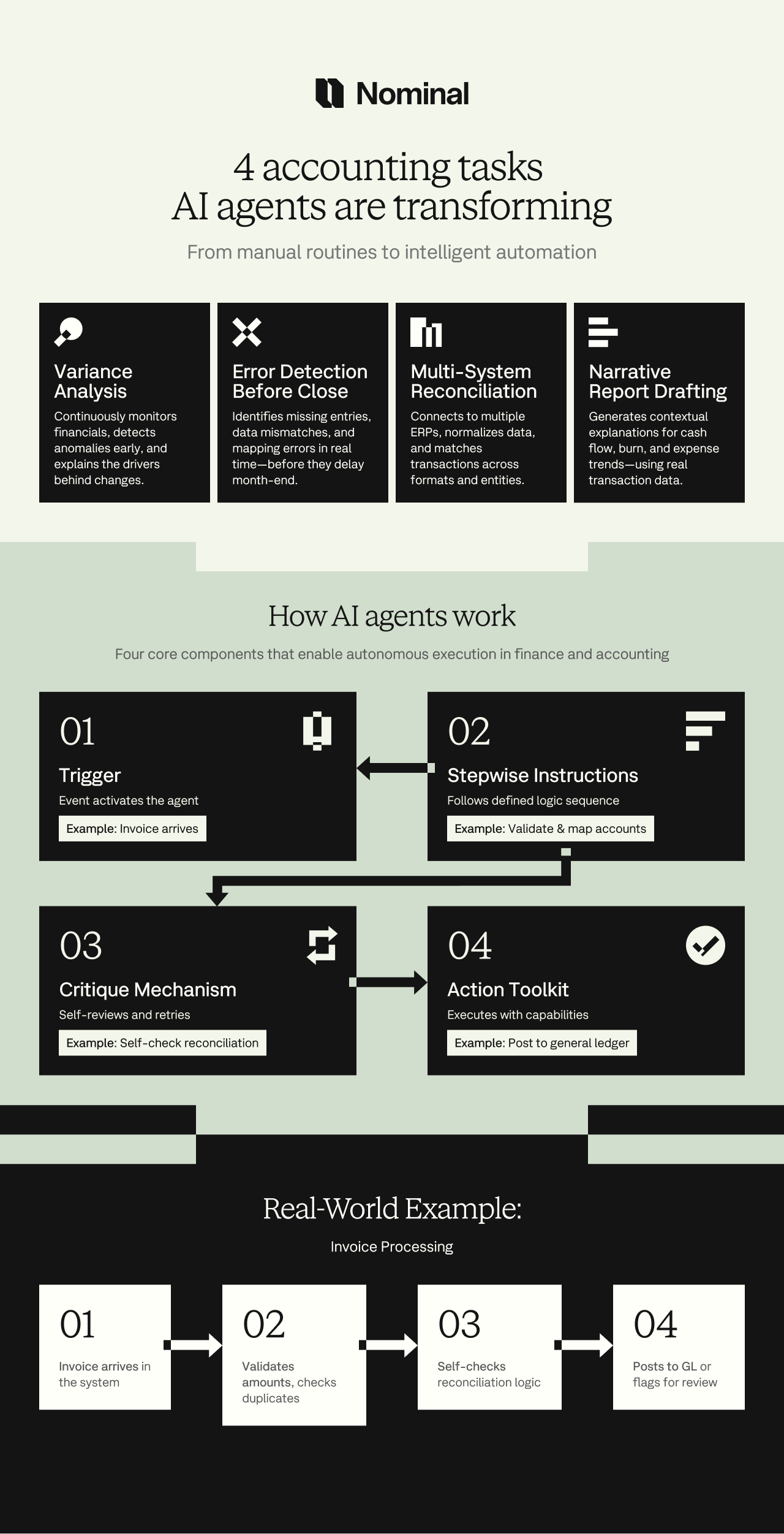
Before fieldwork begins, AI can analyze transaction-level data across all entities to surface anomalies, duplicates, and policy exceptions that manual review would likely miss or catch too late. This kind of early detection shifts the dynamic from reactive to anticipatory. Issues are resolved before they become findings.
For multi-entity accounting teams managing consolidations across subsidiaries, this capability is especially valuable. Intercompany mismatches that once took days to track down are identified in seconds.
You might also like: What Is an Anomaly Detection Agent? How Finance Teams Use AI to Stay Audit-Ready
Automated Reconciliation and Transaction Matching
Reconciliation is where most preparation time is lost. AI-powered matching agents process high volumes of transactions automatically, pairing entries across ledgers, flagging mismatches, and assembling supporting documentation without manual intervention.
This is not just faster. It is structurally better. When reconciliations are automated and consistently documented, the review trail becomes a natural byproduct of the close process rather than something assembled under pressure at year-end.
Finance teams that automate reconciliation also reduce their dependence on tribal knowledge. The logic that used to live in a senior accountant's head now lives in the agent's matching rules, documented and repeatable.
Variance Analysis and Narrative Reporting
Flux analysis is one of the most time-consuming parts of close preparation. Explaining material variances across income statement and balance sheet accounts requires both numerical accuracy and clear business context.
AI agents generate real-time variance analysis tied to operational drivers, producing plain-language narratives that help accounting teams respond to reviewer questions quickly and confidently. This is faster data-to-decision making in practice: less time assembling the explanation, more time reviewing and refining it.
Recommended read: What Are Flux Agents? AI-Powered Variance Analysis for Finance Teams
Continuous Monitoring Instead of Periodic Checks
Traditional close preparation is periodic by nature. Teams reconcile at month-end, review at quarter-end, and scramble at year-end. AI enables a different operating model entirely.
With continuous monitoring, transactions are validated as they occur. Policy exceptions are flagged in real time. Month-end close becomes a confirmation of what agents have already tracked, rather than a discovery process. By the time a formal review arrives, the work is largely done.
Building an Audit-Ready Accounting Function
Embedding AI into close preparation is not a single implementation decision. It is a shift in how the accounting function operates month-to-month. The teams that benefit most are those that treat compliance readiness as a continuous state, not a seasonal event.
Download the Finance Audit Checklist to build your review-ready workflow from the ground up.

Standardize the Monthly Close Before Review Season
Every monthly close should be treated with the same rigor as year-end. Consistent reconciliation standards, immediate documentation of significant transactions, and clear ownership of each account schedule create the foundation that makes external reviews predictable.
When the close process is disciplined year-round, formal preparation is not a separate effort. It is already done.
Centralize Documentation with Clear Ownership
A single source of truth for all supporting documentation is non-negotiable for compliance readiness. Structured folder hierarchies, consistent naming conventions, and controlled access ensure that both internal stakeholders and external reviewers find what they need without delay.
More importantly, centralized documentation removes the dependency on institutional knowledge. When any member of the accounting team can locate and understand a reconciliation, the function becomes more resilient and more scalable.
Embed AI Agents Into Close and Reconciliation Workflows
The value of AI in accounting compounds over time. Teams that integrate intelligent agents early, well before review season, operate with systems that are already tested and trusted when it matters most.
Nominal's agents handle reconciliation, anomaly detection, variance analysis, and intercompany accounting across entities without disrupting existing ERP workflows. The accounting team retains full control and oversight. The agents execute the repeatable work.
.png)
Maintain Proactive Communication with External Reviewers
Engaging with reviewers throughout the year, not just during fieldwork, builds transparency and surfaces potential issues before they affect the timeline. Regular touchpoints create a shared understanding of the accounting team's processes, which typically leads to smoother, faster engagements.
Build Team Fluency in AI-Assisted Accounting
Technology delivers its full value only when the people using it understand what it produces. Training accounting teams to interpret agent outputs, validate results, and apply professional judgment alongside automation is what separates a well-implemented AI system from an underutilized one.
The Strategic Outcome: A Leaner, Faster, More Resilient Accounting Team
The most important benefit of running a financial audit with AI is not speed, though reviews do move faster. It is not accuracy, though fewer errors reach fieldwork. It is what becomes possible when the accounting team is no longer consumed by operational execution.
When AI agents handle reconciliations, flag anomalies, and generate variance narratives, senior accountants shift from doing to leading. They review, analyze, advise, and contribute to decisions that move the business forward. The accounting function stops being a cost center that scales with headcount and becomes a strategic capability that scales with intelligence.
Compliance and readiness become a byproduct of how the team operates every month, not a crisis that arrives every December.
That is the accounting function that modern, fast-growing companies need. And it is entirely within reach.
Ready to see how Nominal's agents transform close preparation into a continuous, scalable process? Book a demo and experience a new standard for accounting operations.


.png)
