

An anomaly detection agent is an AI system that continuously monitors financial data to identify errors, irregularities, and policy violations before they affect the close or trigger audit findings. Finance teams use these agents to replace manual exception review with automated, real-time controls across every entity and account.
Finance teams have always known that errors hide in the data. A misclassified expense here, a recurring vendor payment that suddenly disappears, a transaction memo that contradicts the account it was posted to. The problem is not awareness. The problem is scale. When a team is managing thousands of general ledger entries across multiple entities during a compressed close cycle, catching those errors manually is not just difficult. It is, in practice, nearly impossible.
Anomaly detection agents change that. These AI systems monitor financial data continuously, flagging irregularities as they happen rather than waiting for someone to stumble across them during reconciliation or, worse, during an audit. Nominal builds this capability into its platform through Transaction Patrol, a set of AI agents designed specifically for multi-entity finance teams that need continuous GL monitoring without adding headcount. For finance teams that are serious about data quality and audit readiness, understanding how these agents work is quickly becoming essential knowledge.
This post explains what the agent is, how it works, and why it represents a fundamentally different approach to financial controls than the rule-based tools most teams are familiar with.
What Is an Anomaly Detection Agent?
An anomaly detection agent is an AI system built to identify patterns, inconsistencies, and irregularities in structured data. In a finance context, it monitors general ledger activity across entities and flags transactions that deviate from expected behavior, contradict accounting logic, or break established patterns.
The key distinction between this type of agent and a traditional exception management tool is how each one reaches its conclusions. Rules-based tools operate on deterministic logic: if a transaction exceeds a specific threshold, flag it. If a vendor is missing, raise an alert. These configurations are useful, but they are rigid. They can only catch what someone thought to configure in advance, and they have no capacity to understand context.
AI agents work differently. They read the content of transactions, including descriptions, memos, vendor names, account classifications, and historical patterns, and use that full context to identify problems that no rule could anticipate. They do not just check conditions. They understand what a transaction is supposed to mean and flag it when something does not add up.
This is why the technology is considered a genuine AI application rather than simple automation. The system is making contextual judgments, not executing predetermined logic.
You might also like: Modern Accounting Tools: Excel vs RPA vs AI Agents Compared
Why Manual Exception Review No Longer Works
Most finance teams are not performing comprehensive exception reviews during close. They do not have the bandwidth for it. Controllers are managing reconciliations, variance analysis, and reporting deadlines simultaneously, and asking them to also review transaction logs line by line is simply not realistic.
The result is a gap that compounds over time. Errors that go undetected in October become harder to untangle in November. Issues that make it through to the auditors create rework at the worst possible moment. And some problems never surface at all, quietly distorting financial data until they become material.
The traditional response has been to tighten ERP configurations or invest in rules-based exception reporting. These tools create structure, but they do not solve the underlying problem. They operate reactively, generate noise, and cannot detect the kinds of errors that require semantic understanding to spot. A rules engine cannot tell you that a transaction described as a laptop purchase was incorrectly booked to software expenses. An AI agent can.
How an Anomaly Detection Agent Works
Understanding what happens inside these agents helps explain why they are more effective than the tools that came before them. The workflow follows five distinct stages, each designed to balance analytical depth with human oversight.
1. Data Pre-Processing
Before any analysis begins, the system filters out immaterial and recurring transactions that would create noise without adding signal. For finance teams managing high-volume accounts with hundreds of thousands of entries, this step is critical. Without it, the agent would be overwhelmed by data that has no bearing on the anomalies it needs to find.
2. Agent Analysis
Each agent follows specific instructions tailored to its assigned anomaly type. The agent reads transaction content, including descriptions, amounts, account classifications, and historical patterns, and identifies entries that match its criteria for a potential issue.
3. Agent Decision
When the agent identifies an anomaly, it flags it as a potential alert. This is not a binary match against a rule. It is a judgment call based on context, which is what separates AI agents from deterministic automation.
4. Agent Critic
A second, independent LLM is assigned to review the first agent's output before it reaches the user. This critic layer checks the reasoning and filters out false positives, reducing noise and improving the quality of what gets surfaced. The result is that users only see alerts that have passed a two-layer review.
5. User Review
Finance professionals retain full control over the outcome. They can accept an alert, dismiss it, add comments, or escalate it into a task for investigation. The agent never takes action autonomously. Every decision it surfaces is a recommendation, not a conclusion.
This human-in-the-loop design is intentional. The agent does the work of identifying what deserves attention. The human does the work of deciding what to do about it.
The Three Core Agent Types
Not all anomalies look the same. Effective AI agents for anomaly detection are specialized, each trained to catch a different category of error.
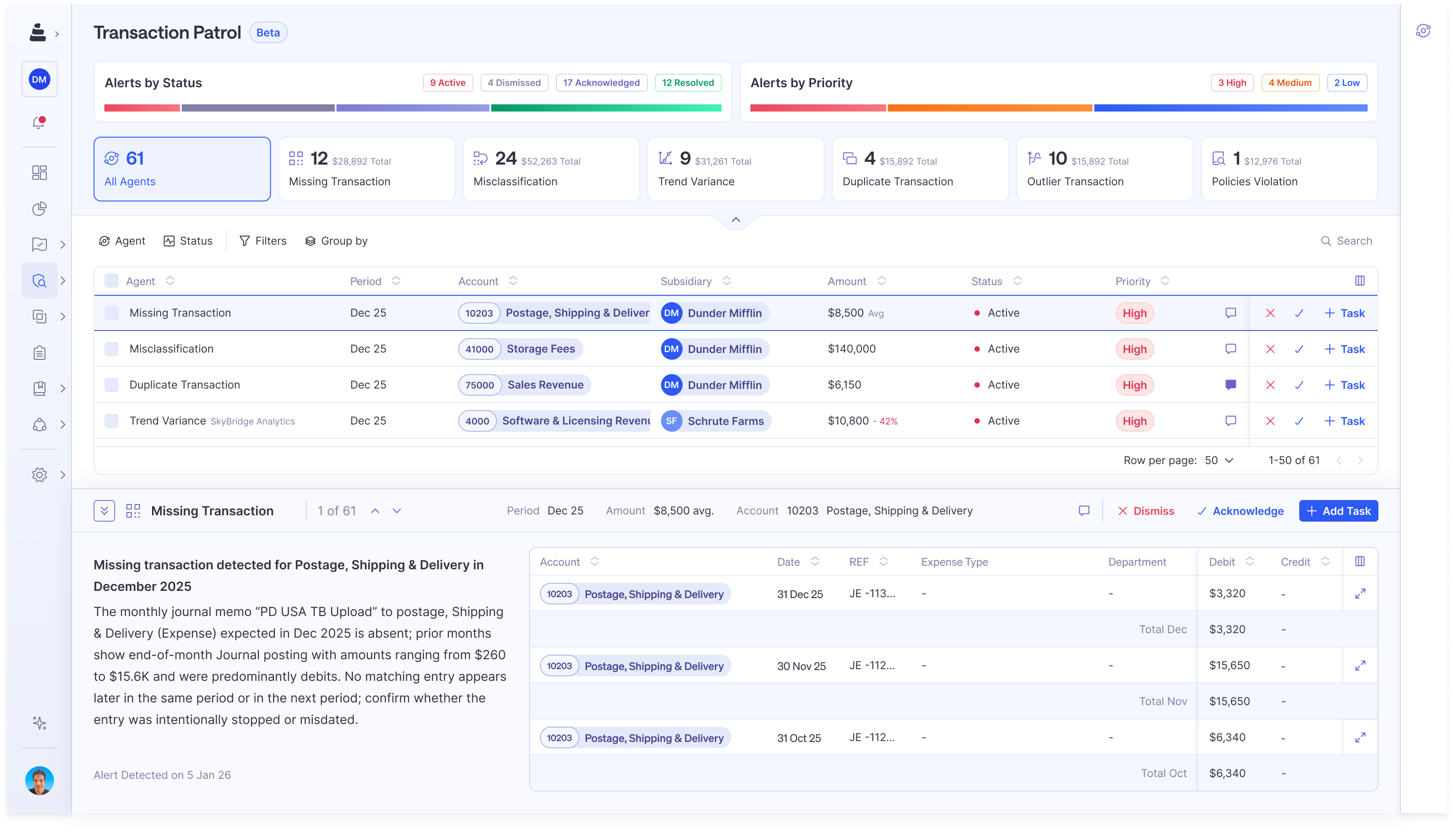
Missing Transaction Agent
This agent identifies recurring transactions that suddenly drop off. It does not just look for a single missing entry. It recognizes patterns: a vendor that has appeared every month for a year, a utility payment that comes in three installments, a payroll charge that occurs on a predictable schedule.
When that pattern breaks, the agent flags it, even when the missing amount is spread across multiple line items. This is something the human eye simply cannot track reliably at scale.
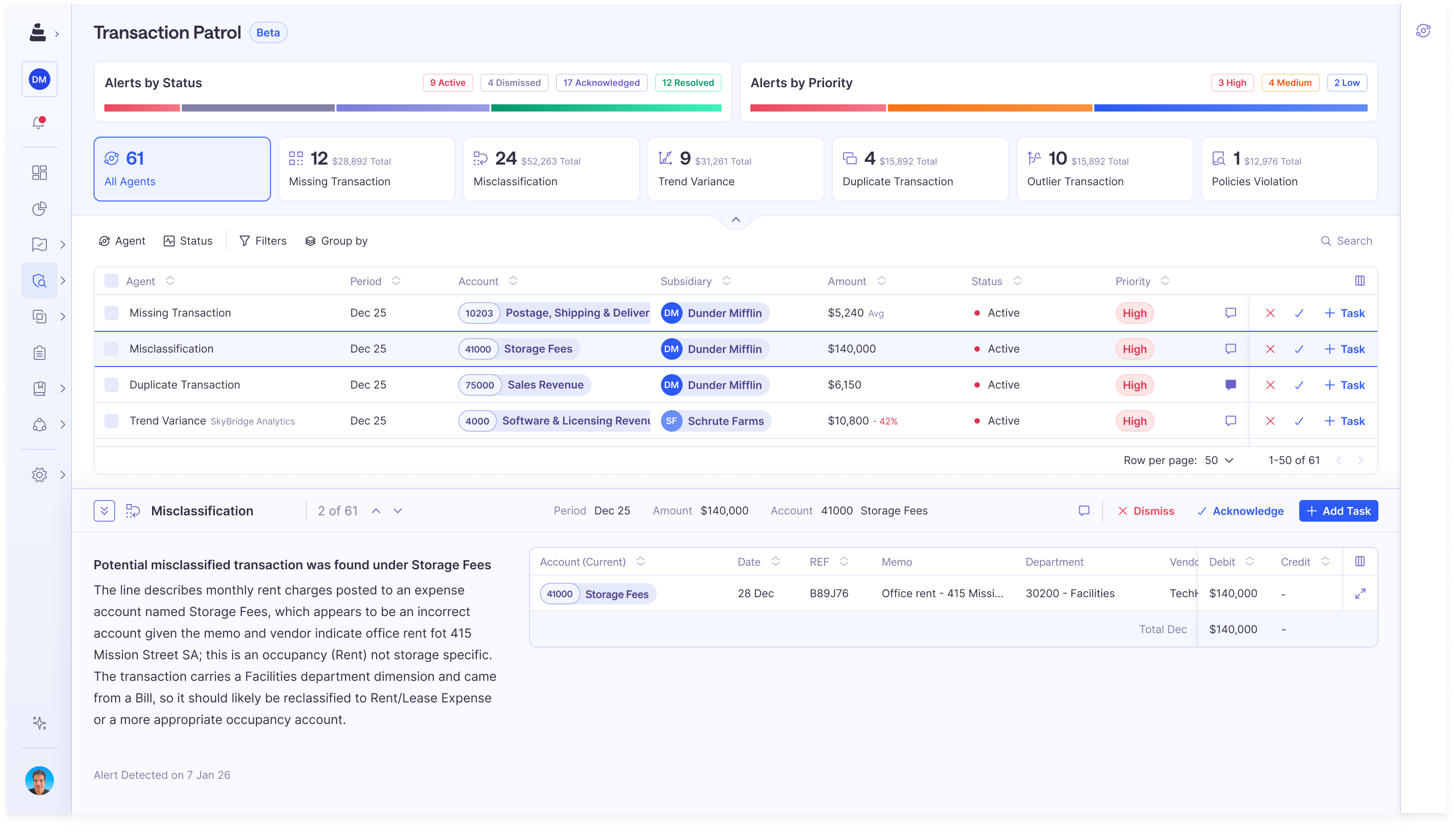
Misclassification Agent
This agent detects contradictions in transaction semantics. The clearest example is a transaction with a revenue description that was posted to an expense account. But the more valuable catches are subtler. A laptop purchase booked to software subscriptions. A meal expense filed under travel. A vendor dimension attached to a revenue entry.
These are the kinds of errors that make it through precisely because they are not obvious, and they are exactly the kind of problem that requires contextual understanding to surface.
Trend Variance Agent
This agent monitors spending and revenue patterns over time and flags unexpected shifts. If a vendor's monthly charge doubles without explanation, or if revenue from a specific customer drops sharply against historical trends, the agent raises an alert. Teams that previously tracked these patterns manually in spreadsheets now have them monitored automatically, without the spreadsheet.
Recommended read: What Are Flux Agents? AI-Powered Variance Analysis for Finance Teams
From Anomaly Detection to Audit Readiness
The value of these agents extends beyond catching individual errors. When they run continuously, they change the entire rhythm of financial operations.
Instead of arriving at month-end with unknown data quality issues, finance teams close with a running log of what was flagged, reviewed, and resolved. Controllers know where the problems are before the reconciliation sprint begins. Auditors encounter books that have been monitored in real time, not cleaned up in the final days before fieldwork.
This is the difference between periodic fire drills and continuous controls. Traditional audit preparation is reactive: assemble documentation, investigate findings, explain variances under pressure. With agents running throughout the period, that process becomes proactive. Issues are caught when context is fresh, fixes are straightforward, and the cost of correction is low.
Nominal's Transaction Patrol is the implementation of this concept built specifically for multi-entity finance teams. It monitors every account across every entity, continuously, using the three agent types described above. Customers have identified and corrected errors that had gone undetected for months, arriving at audit season with confidence rather than uncertainty.
Explore more on this topic: AI in Audit: Automating Reconciliations and Financial Reporting
Anomaly Detection Agent vs. Rules-Based Tools: What Is the Difference?
Not all exception management approaches are equal. Understanding where rules-based tools stop and AI agents begin helps finance leaders make better decisions about where to invest in controls.
What Rules-Based Tools Do Well
Rules-based exception tools have their place. They are good at enforcing clear, predetermined policies: require approval for any AP posting above a specific threshold, flag entries posted without a required dimension, alert when an account exceeds a budget ceiling. These are valid controls and relatively straightforward to configure.
Where Rules-Based Tools Fall Short
The limitation is scope. A rules-based tool can only catch what it was told to look for. It has no capacity to notice that a transaction description refers to office furniture, but the entry was coded to marketing.
It cannot observe that a specific vendor has been absent for two months when that vendor has appeared every month for the prior eighteen. It cannot recognize that a pattern of revenue recognition looks inconsistent with historical timing. The errors that cause the most damage are often the ones no one thought to write a rule for.
Why AI Agents Cover the Gap
AI agents are not executing logic. They are reading data the way an experienced accountant would, looking for what does not fit, even when no rule was written to catch it. This is also why purpose-built finance agents outperform general-purpose LLMs for this task.
A general AI assistant has no connection to the ERP, no access to GL history, and no preprocessing to reduce context overload. An agent built for finance is embedded in the data, configured for the customer's chart of accounts, and optimized to surface what actually matters.
What to Look for in an AI Agent for Anomaly Detection
For finance teams evaluating this category of tooling, a few capabilities separate genuinely useful implementations from tools that add noise without adding value.
- Direct ERP integration: The agent needs access to the full general ledger, not a data export or a sample. Catching what does not belong only works if the agent can see the complete picture, including historical patterns, account structures, and transaction-level detail.
- Human-in-the-loop design: The agent should surface findings for human review, never act autonomously on the books. Finance data is sensitive, and the human judgment layer is not optional. It is the point.
- Semantic understanding, not just threshold checks: Look for agents that use LLMs to read transaction content, not just compare numbers against rules. The errors that matter most are often the ones that a rule would never catch.
- Alert prioritization and a critic layer: A high-volume alert list that mixes genuine problems with false positives trains teams to ignore it. Quality implementations include a review step that validates findings before they reach the user.
- Feedback loop: When a team dismisses an alert because it is not actually an issue, the agent should learn from that decision and not repeat the same flag. Over time, the system should become more precise, not more repetitive.
Anomaly detection agents represent a meaningful shift in how finance teams manage data quality and internal controls. Instead of relying on periodic manual reviews that cannot scale, or rules-based tools that cannot reason, these agents monitor GL activity continuously, understand context, and surface the kinds of errors that have historically slipped through.
For teams managing multi-entity operations, the impact is direct: fewer surprises at close, cleaner data heading into audits, and controllers who spend less time firefighting and more time on analysis that actually moves the business forward.
If your team is still relying on manual exception review or rigid rules to catch GL errors, it may be time to see what a purpose-built anomaly detection agent can do. Book a demo to see how Nominal's Transaction Patrol works in a live environment.