

D365 F&O captures intercompany transactions with precision but can't execute reconciliation autonomously. Agentic Performance Management closes the execution gap by deploying Resolution Agents that match, investigate, and adjust transactions across entities automatically.
Your ERP captured 10,000 intercompany transactions this month with perfect precision. Every invoice, every payment, every transfer between legal entities is stored accurately in the system. The database integrity is flawless. Compliance is maintained. The audit trail is complete.
Now someone needs to reconcile all of it.
This is the intercompany gap that enterprise finance teams face daily. Dynamics F&O excels at recording complexity, storing every transaction with meticulous detail across multiple entities, currencies, and jurisdictions. The system does exactly what it was designed to do: maintain an accurate, compliant system of record for global operations.
What the ERP wasn't designed to do is execute the reconciliation work autonomously. Matching transactions across entities, investigating timing differences, resolving currency variances, and preparing eliminating entries still require finance team involvement. The platform records transactions perfectly as intended, while resolution workflows happen outside the system.
The Intercompany Math Problem
Enterprise finance teams face an exponential complexity problem that requires additional execution capabilities beyond what the ERP was designed to provide.
The math is simple but brutal. A company with 10 legal entities has 90 potential transaction pairs. Not every entity transacts with every other entity, but enough pairs are active to create significant reconciliation work. Each pair introduces multiple variables that the system records but doesn't resolve.
The Variables That Compound
.png)
Timing differences occur constantly
Entity A records a sale to Entity B on March 31. Entity B records the corresponding purchase on April 1. Both entries are accurate within their respective ledgers, but they don't match across the month-end. The ERP captures both sides of the transaction flawlessly. Someone still needs to identify the mismatch and determine how to handle it for consolidation purposes.
Currency fluctuations introduce variances that require investigation
Entity A invoices Entity B for $100,000. The exchange rate shifts between the invoice date and the payment date. Dynamics F&O records the variance in both ledgers with accuracy, but the system doesn't autonomously calculate the adjustment needed for eliminations or prepare the correcting entry.
Coding discrepancies create mismatches that only appear during consolidation prep
Entity A codes an intercompany expense to account 7100. Entity B codes the corresponding intercompany revenue to account 4150 instead of the standard 4100. The error sits in the system for weeks because both transactions look correct in isolation. Discovery happens late in the close cycle when finance teams are already under pressure.
The Human Middleware Tax
Each of these scenarios requires execution capabilities beyond the ERP's core design. Senior accountants export data from multiple instances into Excel, then build macros to match transactions across entities. Discrepancies require manual investigation. Adjusting entries are prepared in spreadsheets before being imported back into the system.
The work isn't intellectually complex. It's operational volume. Enterprise finance teams spend days on intercompany reconciliation, not because the logic is difficult, but because these execution workflows happen outside the system. Teams bridge the gap between what the ERP records and what consolidation requires.
Recommended read: The ERP Accounting Gap: What Mid-Market Finance Teams Need to Know
Where D365 F&O Excels and Where It Doesn't
Understanding the execution gap requires acknowledging what F&O does well and recognizing where additional execution capabilities add value.
What the Platform Does Well
The system provides integrated functionality built directly into the architecture. Mirrored journal entries post across entities automatically. Shared vendor and customer databases eliminate duplicate data entry. Multi-currency transactions are captured with precision, maintaining separate functional and reporting currencies without data loss.
Data integrity is exceptional. Every debit has a corresponding credit. Every transaction includes complete audit trails. Compliance requirements are met through built-in controls and reporting. For global operations spanning dozens of legal entities, the platform serves as a sophisticated, reliable system of record.
You might also like: Why Business Central Users Hit a Scaling Wall And How APM Breaks Through
Where Additional Execution Capabilities Add Value
True consolidation often requires setting up a separate "consolidation company" within the system. Multi-entity support is robust, though data synchronization between entities typically requires scheduled updates. Accounting teams run these updates to ensure they're working with current information before starting cross-entity analysis.
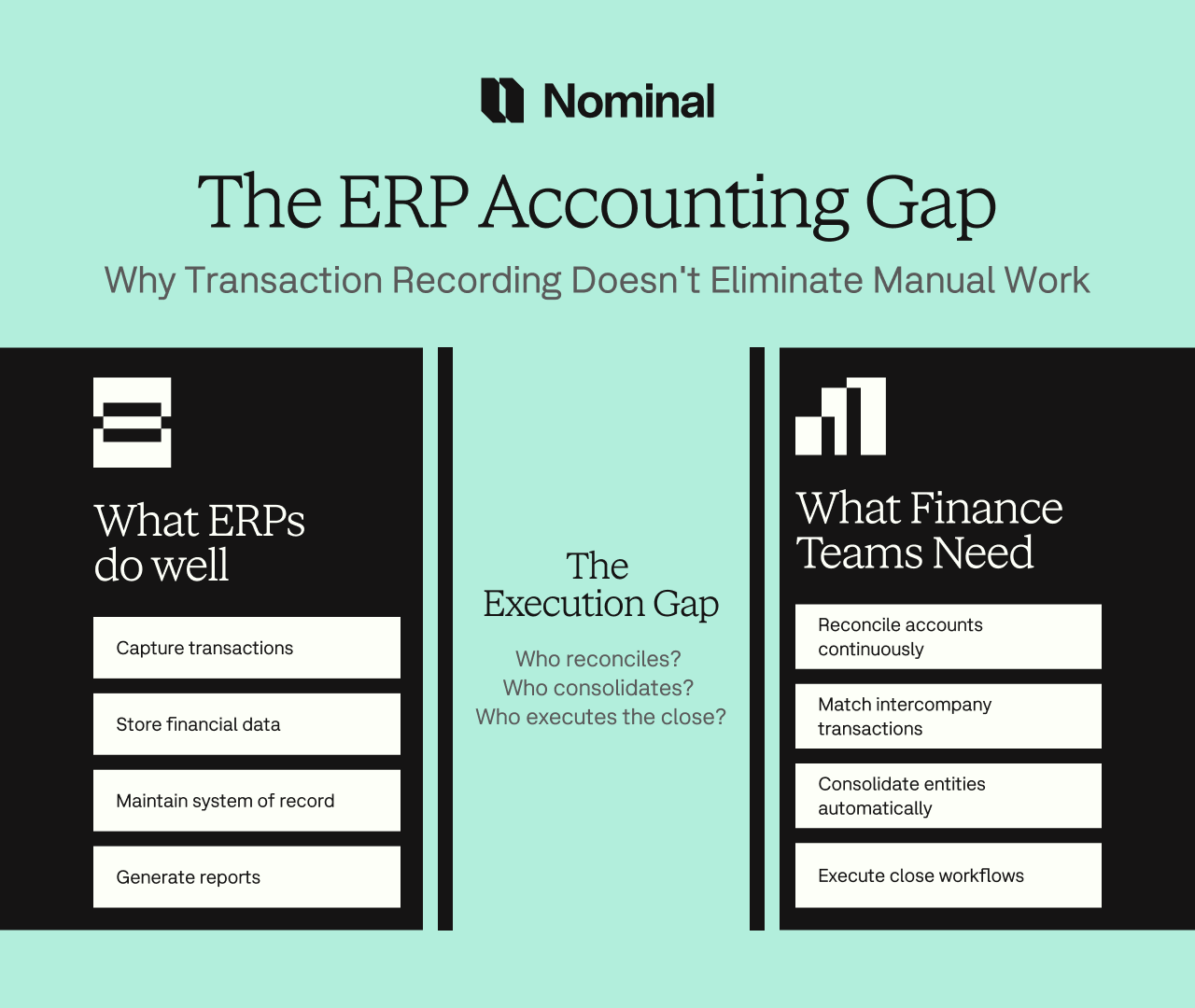
Intercompany eliminations present operational complexity at scale. While native tools exist for handling these transactions, enterprise scenarios often involve variables the standard workflows weren't designed to handle automatically: timing differences across time zones, multi-currency fluctuations, and entity-specific coding conventions.
Exception handling follows the traditional ERP design philosophy. The system provides reports and alerts that surface mismatches for accountants' review. Resolution workflows happen outside the platform, where teams have the flexibility to apply judgment and business-specific rules to each situation.
Three Scenarios That Benefit from Autonomous Execution
Scenario 1: The Timing Mismatch
Entity A (US subsidiary) records a management fee charge to Entity B (UK subsidiary) on March 31, the last day of Q1. The wire transfer initiates, and the accounting team posts the company revenue.
Entity B receives notification of the incoming management fee on April 1. Their accounting team posts the intercompany expense in Q2. Both entries are correct according to each entity's internal processes.
Dynamics F&O captures both transactions. The consolidation workflow requires additional steps because teams need to determine whether to adjust Entity A's timing, adjust Entity B's timing, or create an accrual entry.
Teams export both ledgers, identify the timing difference, determine the appropriate treatment based on company policy, and prepare the adjustment.
Scenario 2: The Currency Fluctuation
Entity A (USD functional currency) invoices Entity B (EUR functional currency) for $100,000 on January 15. Exchange rate at invoice date: 1 USD = 0.92 EUR. Entity B records €92,000 payable.
Payment processes on February 15. Exchange rate at payment date: 1 USD = 0.89 EUR. Entity B pays €89,000. The variance ($3,000 equivalent) represents a foreign exchange gain for Entity B and a loss for Entity A.
The ERP records every piece of this transaction accurately in both functional and reporting currencies, maintaining complete audit trails. When finance teams prepare consolidated eliminations, they calculate the elimination adjustment and determine how to allocate the variance between entities for reporting purposes. This analysis happens outside the platform where teams can apply company-specific policies.
Related post: What Are Flux Agents? AI-Powered Variance Analysis for Finance Teams
Scenario 3: The Coding Discrepancy
Entity A sells inventory to Entity B for $50,000. Entity A correctly codes the transaction to the intercompany revenue account 4100. Entity B receives the inventory and codes the expense to account 7100, which is correct.
However, Entity B's AP team processes the invoice and accidentally codes it to standard COGS account 5100 instead of the intercompany COGS account 7100. The error doesn't trigger immediate alerts because 5100 is a valid expense account, and the transaction balances properly within standard validation rules.
Discovery happens three weeks later during reconciliation prep. The system has maintained a complete audit trail as designed. Finance teams identify the miscoding through their reconciliation process, investigate the root cause, prepare a reclassification entry, and post the correction. This quality control workflow happens outside the automated posting process.
How Agentic Performance Management Closes the Gap
Agentic Performance Management (APM) introduces autonomous execution capabilities that complement the ERP's system of record foundation.
Autonomous Intercompany Reconciliation
Agents sit above the multi-entity structure in Dynamics F&O, connecting to multiple instances simultaneously. These agents detect and reconcile transactions across different ledgers, currencies, and subsidiaries without requiring manual data exports.
They handle the three scenarios described earlier autonomously:
- Timing mismatches? The system identifies transactions that match in amount and entity pair but differ in posting date, then applies configurable rules to determine adjustment treatment.
- Currency fluctuations? Agents calculate FX variances automatically and prepare the elimination adjustments needed for consolidation.
- Coding discrepancies? Pattern recognition flags unusual account usage and prepares reclassification entries for review.
Enterprise finance teams using this capability report cutting currency conversion and elimination work from days to hours. What previously required three days per month of Excel-based reconciliation now happens continuously, with finance reviewing and approving reconciliations rather than building them from scratch.
Resolution Instead of Recording
Transaction Patrol monitors the General Ledger across all entities for misclassifications, posting errors, and anomalies. This monitoring layer adds autonomous resolution capabilities to the ERP's alert system. Resolution Agents prepare correcting entries automatically based on configurable rules.
The distinction enhances the standard workflow
The ERP generates reports showing $2.3 million in unmatched transactions across entities. APM adds the execution layer: investigating each transaction, determining the cause of the mismatch, calculating the required adjustment, and drafting the journal entry. Finance teams review and approve rather than investigate and create from scratch.
This shift changes the nature of accounting work
Teams move from reactive troubleshooting to proactive oversight. Senior accountants who previously spent days in Excel matching transactions now spend hours reviewing agent-prepared reconciliations and focusing on exceptions that require judgment calls.
Consolidated Reporting Without Manual Harmonization
Autonomous Agents pull data from multiple instances simultaneously, eliminating the export and consolidation workflow that traditionally consumes the first week of close. Automated variance analysis provides plain-English explanations of what changed and why, drilling down into underlying transactions without manual investigation.
Consolidation prep compresses from weeks to days because the continuous reconciliation work throughout the month means fewer surprises at period-end. The agents have already matched transactions, calculated eliminations, and flagged exceptions. Close becomes a review and approval process rather than a discovery and remediation sprint.
The Tech Stack Reality
Dynamics F&O remains the system of record. All financial data continues to live in the ERP. Compliance requirements are still met through the platform's built-in controls. Audit trails remain intact and complete. APM doesn't replace this foundation.
Instead, APM becomes the autonomous workforce that executes on top of the system of record. The analogy is straightforward: the ERP is the filing cabinet that stores everything perfectly. APM is the accountant who knows what to do with what's inside.
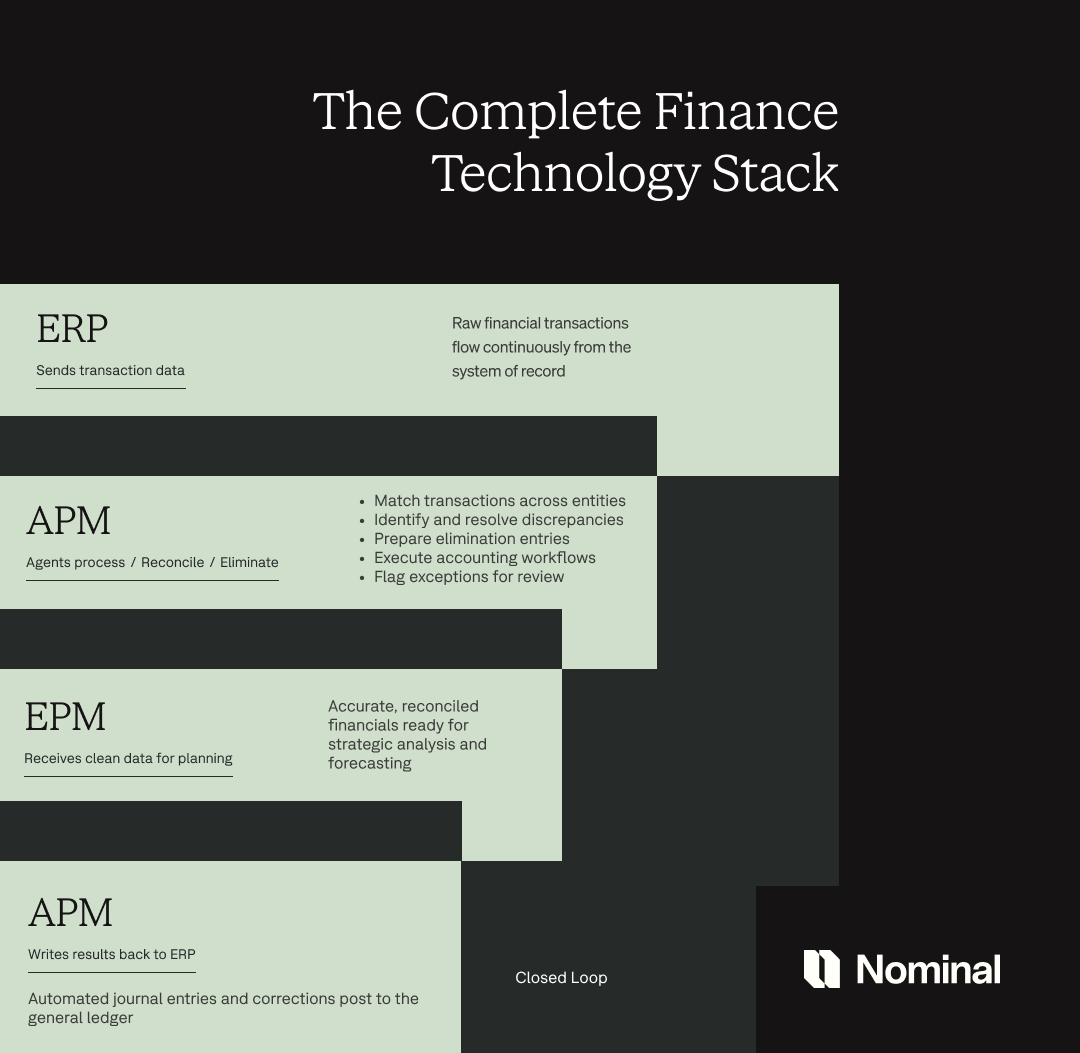
Implementation doesn't require data migration or system replacement. There's no rip-and-replace risk. Finance teams continue using their ERP exactly as they do today. APM layers on top, handling the manual execution work that was never part of the original system design.
Helpful resource: Rethinking the Finance Automation Stack: Why Today’s Tech Architecture Is Unsustainable
D365 F&O provides the foundation teams need: accurate transaction recording, data integrity across global operations, and built-in compliance controls. The gap exists in the execution layer between what the ERP records and what consolidation requires.
Agentic Performance Management adds autonomous execution capabilities that handle the matching, investigation, and adjustment work currently done in spreadsheets. Resolution Agents operate continuously across all entities while the ERP maintains its role as system of record.
Ready to see how enterprise accounting teams are automating intercompany reconciliation across 20+ entities? Book a demo to explore how APM adds autonomous execution capabilities to your existing D365 F&O foundation.