

Close management software helps finance teams coordinate month-end tasks, track deadlines, and document evidence. Nominal's approach integrates automated preparation from AI agents with traditional task tracking, creating an execution layer that reduces manual work while maintaining audit-ready controls for multi-entity operations.
Finance teams adopted close management tools to escape spreadsheet chaos. These platforms brought structure to month-end workflows by centralizing task lists, assigning ownership, and tracking deadlines. The promise was simple: replace fragmented Excel files with a single system where everyone could see progress and nothing would fall through the cracks.
Yet many teams discovered a fundamental limitation. These tools organize the checklist but do not reduce the actual work. Accountants still manually prepare journal entries, chase reconciliations, and rebuild variance analyses each month. The system tracks it all separately, creating a new layer of administrative overhead without eliminating the underlying manual effort.
The question finance leaders should ask is not whether they need close management, but what kind they need. When integrated with the right architecture, it becomes more than a project tracker. It transforms into an execution layer where automated preparation meets human oversight, reducing workload while maintaining the control and audit trail that finance operations require.
What Traditional Close Management Actually Does
Traditional close management software replaces spreadsheet-driven close processes with structured workflows. Teams create task lists with clear ownership, dependencies, and due dates. Documentation is centralized in one location instead of scattered across shared drives and email threads. Status updates become visible in real-time rather than gathered through manual check-ins.
These platforms solve real problems. They eliminate version control issues when multiple people update the same spreadsheet. They reduce the time spent chasing status updates or searching for evidence. They create accountability through clear assignments and audit trails through documented activity.
The value proposition centers on coordination. Finance teams gain visibility into who is doing what, where bottlenecks exist, and whether the close will finish on schedule. For organizations moving away from spreadsheets, this represents meaningful progress in managing the month-end process.
However, coordination is not the same as execution. Traditional systems track the work without reducing it. The checklist items still require manual completion. Reconciliations still need human preparation. Variance explanations still demand analysis and documentation from scratch each cycle.
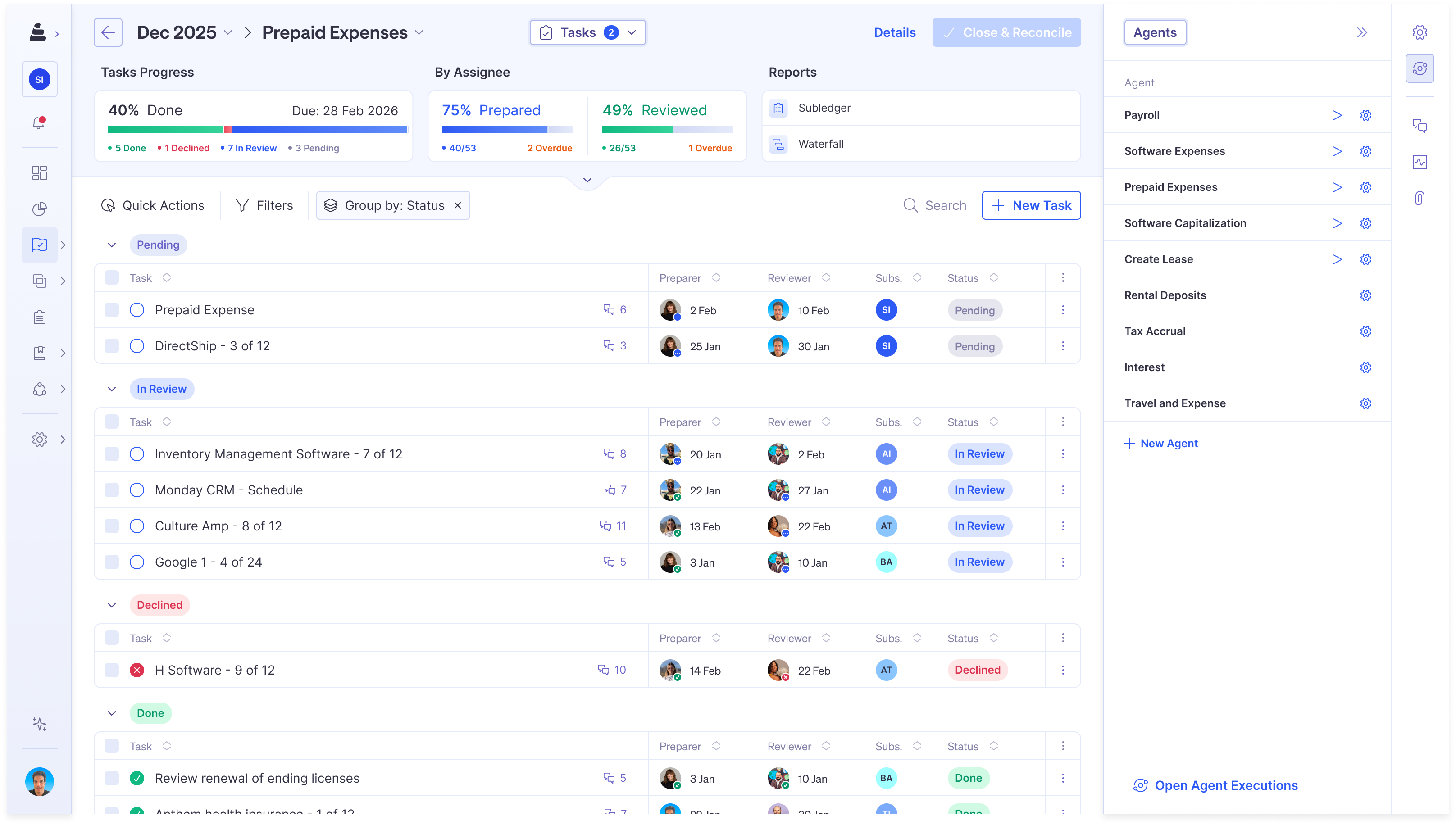
Why Coordination Without Execution Falls Short
The gap between task tracking and actual close work becomes visible as operations scale. Adding entities means adding tasks. Each new subsidiary introduces reconciliations, eliminations, and reporting requirements that someone must complete manually. The system tracks the expanding workload, but nothing reduces the hours required to execute it.
Multi-entity environments expose another weakness. Different ERPs use different data structures. Teams work in different time zones with different processes. Evidence lives in different systems. A coordination tool can organize across these divisions, but it cannot reconcile them. Finance teams still spend hours normalizing data, matching transactions, and consolidating results manually.
The disconnect between the task list and the financial activity creates friction. These systems operate separately from the ERPs generating the transactions. When exceptions occur or data changes, the tracking tool does not know. Teams discover problems late because nothing connects the checklist to the underlying accounting activity driving it.
This limitation matters because month-end close is not purely a coordination challenge. It is an execution challenge. Teams need systems that reduce the manual work itself, not just organize who completes it. Without that capability, efficiency gains plateau quickly as complexity grows.
You might also like: Multi-Entity Reporting: How to Consolidate Financials Across Entities Without Spreadsheets
Close Management as an Execution Layer
Nominal approaches close management from a different architectural foundation. Rather than building a workflow tracker separate from financial operations, the platform operates as the operational hub where human tasks and agent-generated work converge. This integration creates an execution layer instead of a coordination layer.
The distinction matters. In traditional systems, software tracks tasks while humans prepare outputs. In an execution-first model, automated agents prepare draft journal entries, surface exceptions, and reconcile transactions. These outputs enter the workflow as tasks within the same system where teams manage manual work.
This architecture reflects the three-pillar model that makes autonomous execution possible. The General Ledger provides transaction-level data access. Task Management creates oversight and control. Agents perform automated preparation.
The result is a hybrid structure. Most tasks follow standard checklist formats that teams create and own. Some tasks generate automatically when agents detect exceptions or prepare outputs requiring review. Both types flow through the same controlled environment with ownership, evidence, and audit trails.
How Execution-First Operations Work
Teams begin by creating standardized checklists with ownership assignments, deadlines, and dependencies. These templates capture the repeatable structure of each close cycle. Evidence and documentation are attached directly to tasks, eliminating scattered folders and unclear audit trails.
As the close progresses, Nominal's agents operate continuously in the background. Transaction Patrol monitors for misclassifications and policy violations. Matching Agents reconcile transactions across entities and systems. Flux Analysis identifies significant variances at the transaction level. When these agents detect items requiring attention, they generate tasks automatically.
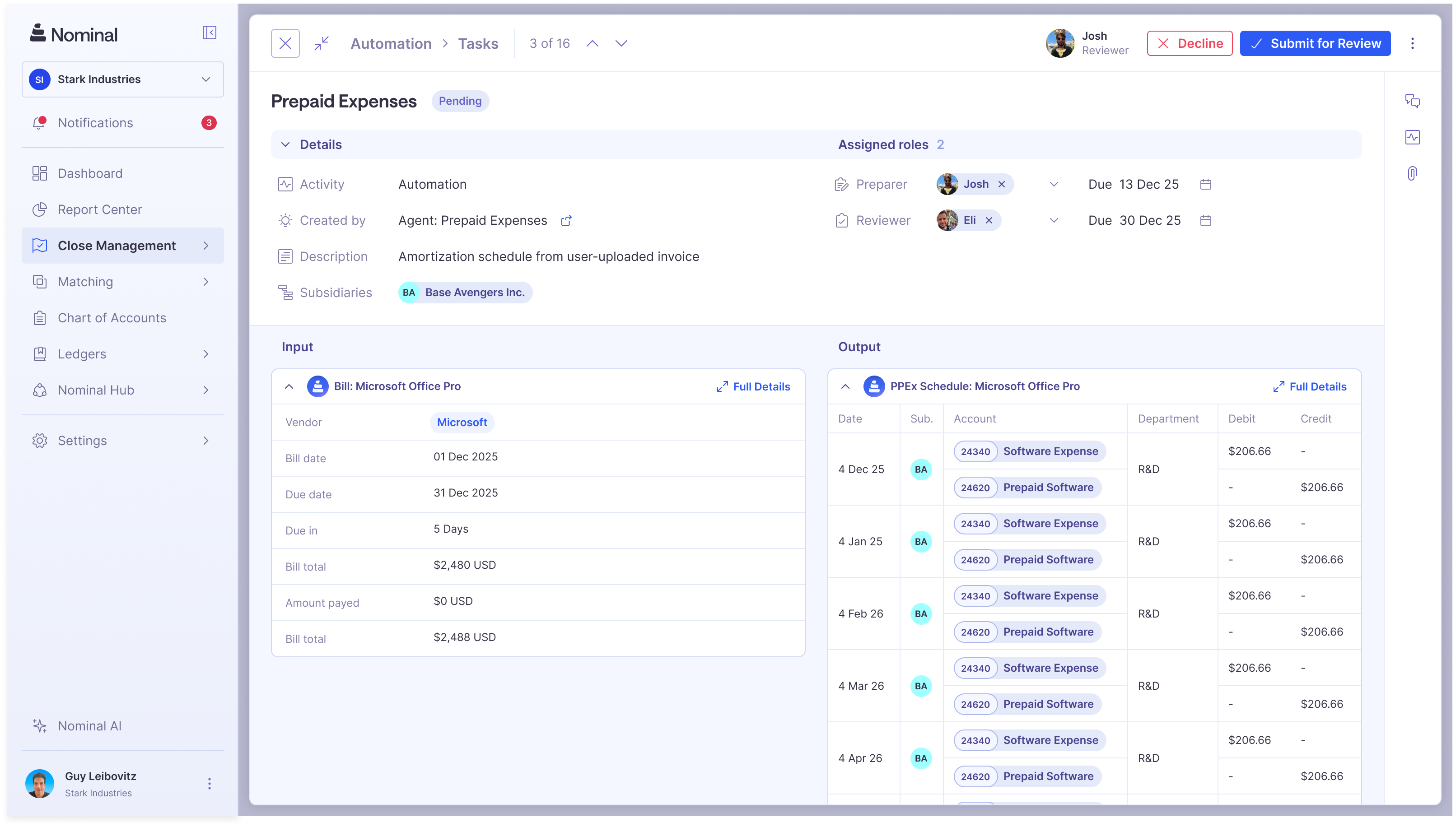
The prepared work enters the same environment where manual tasks live. An accountant reviewing intercompany reconciliations sees both the checklist items they created and the agent-prepared matching results awaiting approval. Controllers gain visibility into progress across all work types without switching between systems or chasing updates through email.
This integration shifts the focus from preparation to review. Teams spend less time rebuilding outputs each month and more time applying judgment to results. Exceptions surface earlier because agents operate continuously rather than waiting for humans to discover problems during final review.
The Multi-Entity Challenge
Multi-entity operations amplify every limitation of coordination-only systems. Each subsidiary may use different ERPs with incompatible data structures. Teams follow different processes in different regions. Evidence scatters across systems that do not communicate. Manual consolidation becomes exponentially more complex as the organization scales.
Traditional tools address this by creating separate task lists for each entity. This provides visibility but does nothing to reduce the underlying work of normalizing charts of accounts, matching intercompany transactions, or preparing elimination entries. Someone still performs these steps manually every month.
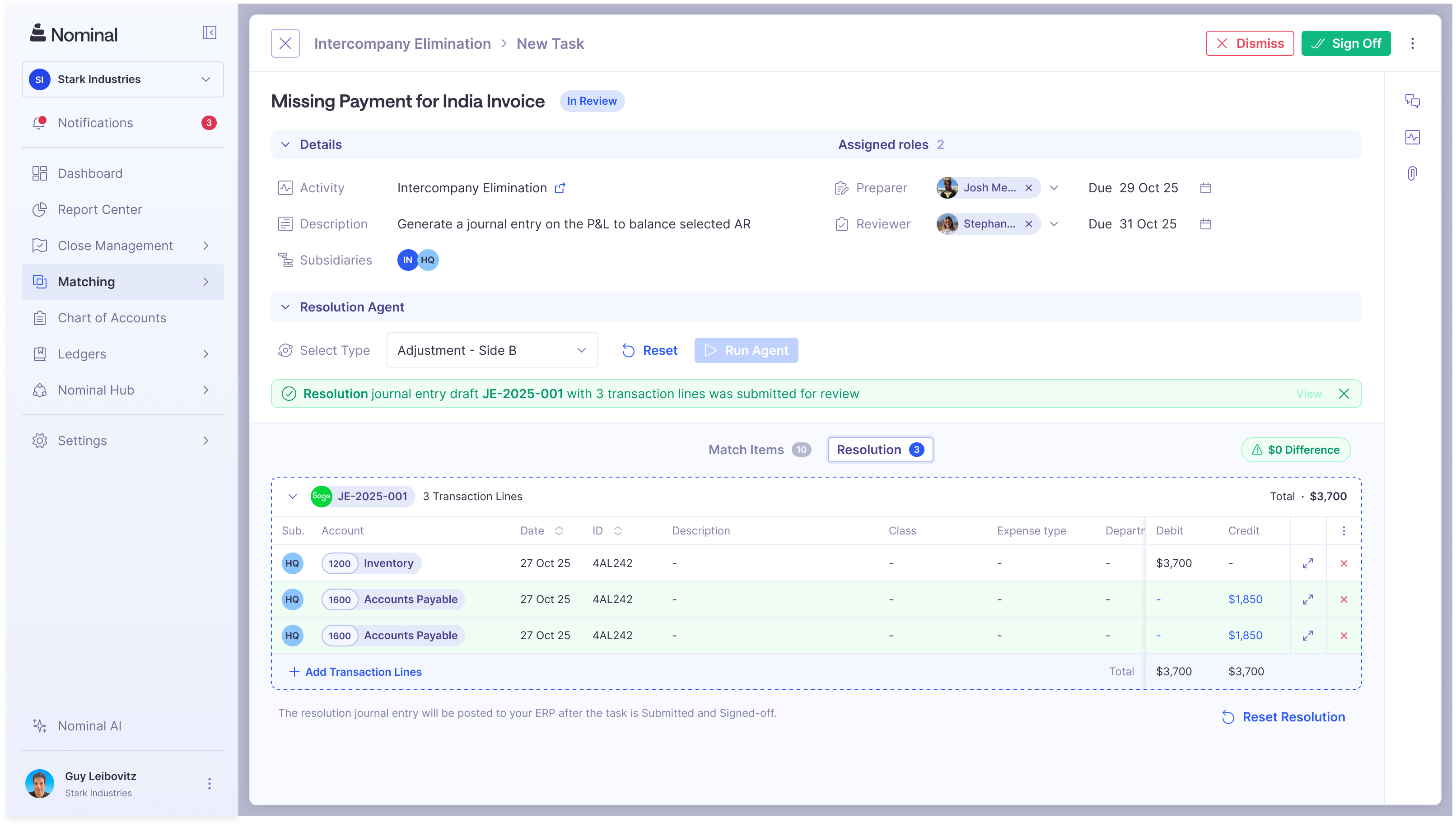
An execution-first model handles multi-entity complexity differently:
- Agents normalize data structures automatically
- Match transactions across entities regardless of which ERP recorded them
- Prepare consolidation entries based on ownership structures and intercompany activity
The work happens continuously rather than concentrated at month-end.
This capability matters because multi-entity environments represent where traditional automation breaks down. Rules-based systems cannot adapt to varying data formats. Manual processes do not scale. Systems that integrate transaction-level access with autonomous execution handle the complexity without requiring expanding headcount or rigid configuration.
The APM Advantage for Close Management
Finance technology has traditionally operated in distinct layers. ERP systems serve as the system of record, maintaining the general ledger and core financial data. EPM platforms provide planning capabilities and close visibility, helping teams forecast and monitor progress. Both are essential, but neither executes the actual work of closing the books.
Agentic Performance Management (APM) fills this gap as the execution layer. APM uses autonomous agents to perform complete accounting workflows, from transaction matching to variance analysis to consolidation entries. Rather than assisting humans or tracking their work, APM agents execute the repeatable operational tasks that consume the majority of close time.
Close management becomes the operational center of this model. It provides the governance framework where agent-prepared work meets human decision-making. Agents handle transaction-level reconciliation, exception detection, and draft preparation. Controllers and accountants review outcomes, approve results, and focus on items requiring judgment rather than spending days on manual preparation.
This positioning matters because it addresses the fundamental limitation of traditional approaches. Coordination tools track what needs to happen. APM makes it happen. The combination delivers both the control finance teams require and the efficiency modern operations demand.
Recommended read: APM vs. EPM vs. Close Management: Understanding Finance's Tech Stack Evolution
Close management tools brought necessary structure to month-end workflows, but structure alone does not solve the scalability challenge finance teams face. As operations grow more complex, coordination becomes insufficient. Teams need execution capability that integrates automated preparation with the oversight and audit trails that close operations require.
The difference lies in architecture: in how deeply these systems integrate with actual financial operations. Tracking tools monitor activity from the outside. Execution platforms operate from within, connecting oversight, data, and automation in one unified layer. This integration delivers the efficiency modern finance organizations require without sacrificing control.
See how Nominal's Close Management integrates AI agents with task oversight to reduce manual work while maintaining audit-ready controls. Book a demo to explore the execution layer.