


Matching agents are AI-powered systems that automatically identify, match, and reconcile transactions across ledgers. Unlike traditional automation, they learn from business logic, handle complex scenarios, and operate with minimal human intervention to accelerate close processes.
Month-end close should not feel like a fire drill. Yet for most finance teams, reconciliation remains a manual, time-intensive process that delays close, introduces errors, and keeps talented professionals buried in spreadsheets instead of focused on strategic work.
Matching agents change this. They bring intelligent, autonomous execution to reconciliation workflows, processing transactions at scale while learning from each customer's unique business logic. This is AI that understands context, adapts to variability, and delivers results that finance teams can trust.
For multi-entity organizations managing high transaction volumes, matching agents represent a fundamental shift in how reconciliation gets done.
Why Reconciliation Is Still Manual for Most Finance Teams
Finance operations have evolved significantly, yet reconciliation remains stubbornly manual for structural reasons deeply embedded in how companies manage financial data.
Fragmented systems create data silos. Most organizations run multiple ERPs across subsidiaries, maintain separate subledgers for AR and AP, and pull bank data from external sources. Each system formats data differently and operates on its own schedule. Bringing these records together requires extraction, transformation, and normalization before any matching can begin.
Spreadsheets become the default workaround. When systems cannot talk to each other, finance teams export data into Excel. This approach works for small volumes but breaks down quickly as transaction counts grow. A single error in a formula can cascade into material misstatements.
Volume and complexity compound the challenge. A company with 30 entities processing 150,000 transactions per month cannot manually review every line. Teams spend days matching invoices to payments, reconciling intercompany activity, and hunting for discrepancies that may or may not exist.
The result is a reconciliation process that delays close, increases audit risk, and traps finance talent in repetitive work.
What Is a Matching Agent?
A matching agent is an AI-powered system that autonomously identifies, matches, and reconciles transactions across multiple data sources. Unlike traditional rule-based automation, matching agents use large language models to interpret business logic, adapt to variability, and execute reconciliation workflows with minimal human intervention.
These agents operate on transaction-level data, not summary balances. This granularity enables them to identify specific discrepancies, classify root causes, and recommend or execute resolutions. They work continuously, maintaining an audit-ready state that reduces close cycle time.
At Nominal, matching agents are part of a three-pillar architecture: a native general ledger that mirrors transactional data, task management for oversight, and AI agents that execute the work. This creates a closed-loop platform where agents do the matching, create tasks for exceptions, and post resolutions back to the GL.
How It Works: Matching, Resolution, and Posting
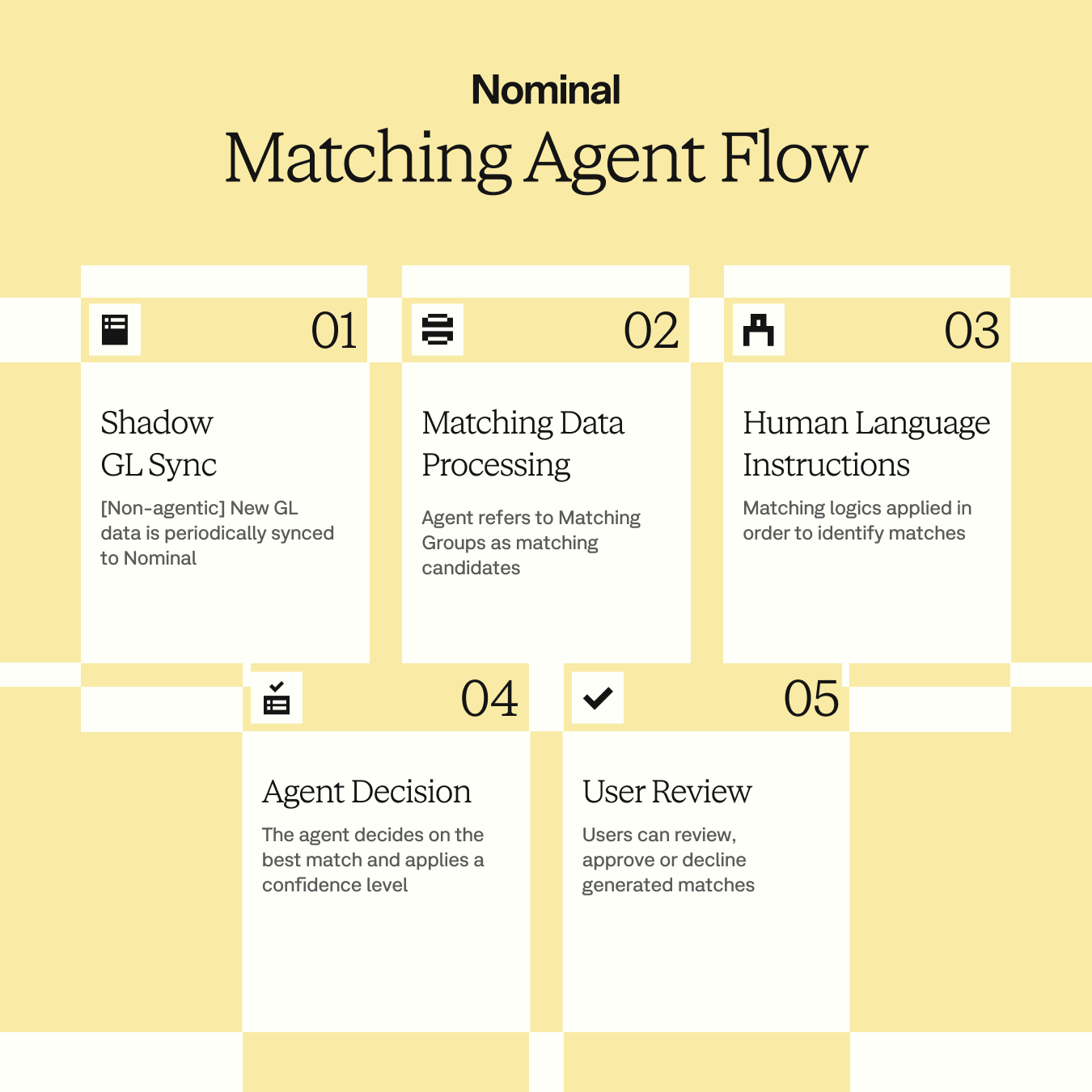
The matching agent workflow replicates how finance teams think about reconciliation while executing at machine speed.
The agent ingests transactional data from multiple sources, including general ledgers, bank feeds, subledgers, and intercompany records. Nominal standardizes this data automatically, normalizing chart of accounts and applying currency conversions.
Next, the agent applies matching logic configured in natural language. Teams define matching groups and instructions. For example, an intercompany agent might match transactions where the customer dimension from one entity appears in the memo field of another, allowing for timing differences within five days.

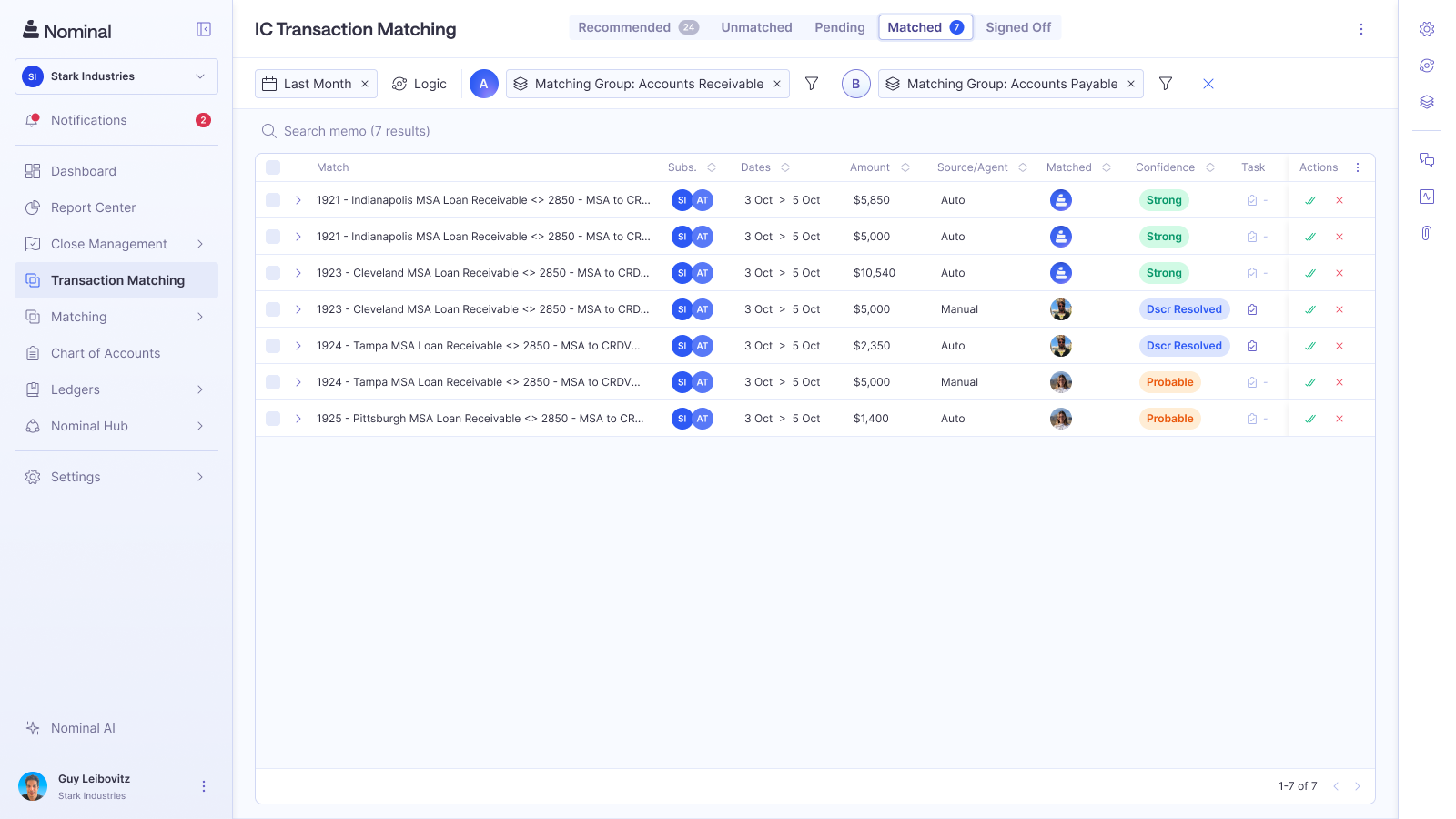
The agent categorizes results by confidence level. Strong matches are automatically placed in the matched queue.
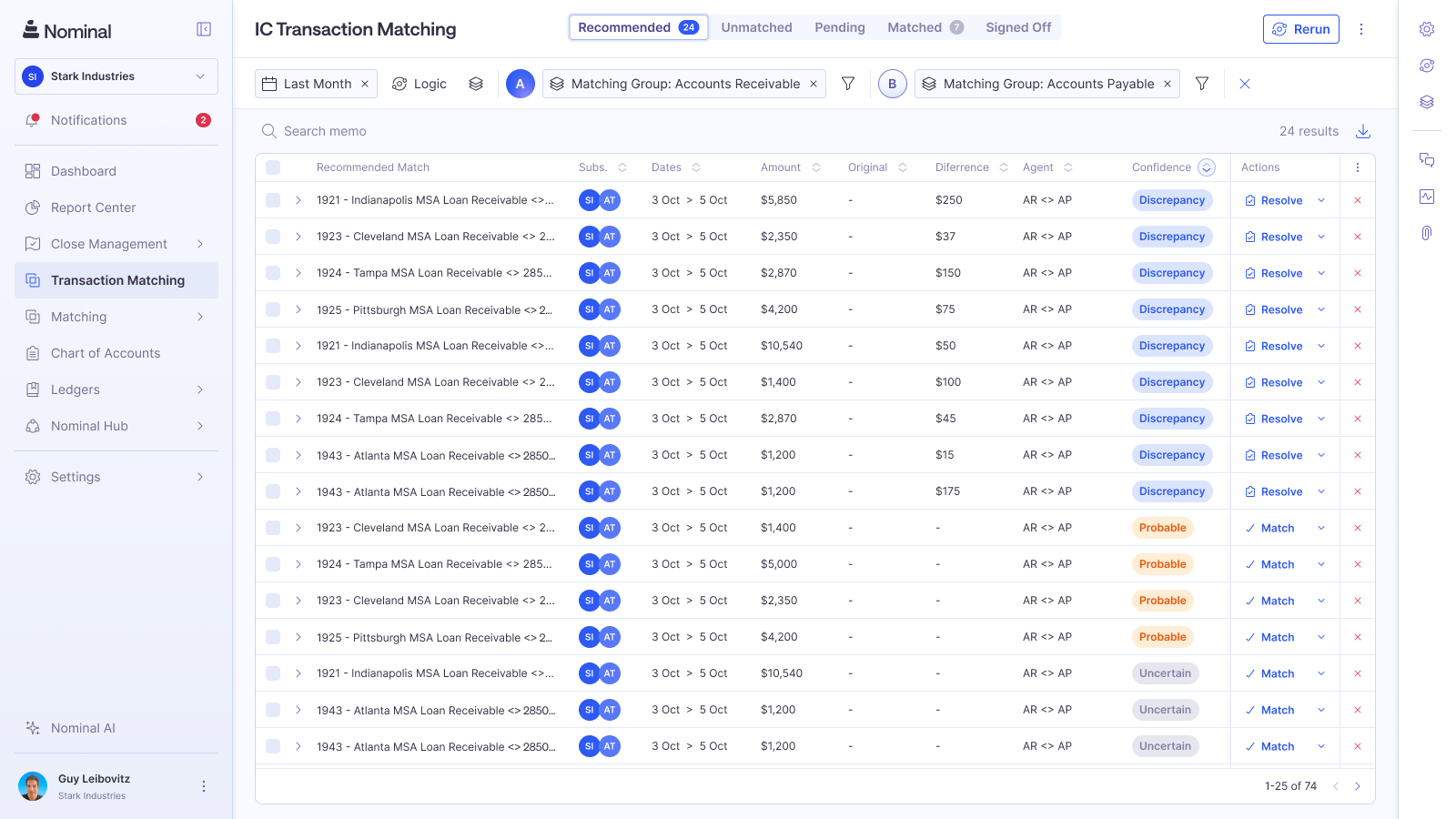
Possible matches are flagged for review. Discrepancies are surfaced with suggested classifications, such as timing differences or FX variances.
When discrepancies are identified, the resolution agent takes over, evaluates the mismatch, and either executes the adjustment or creates a task for human review.
Finally, a post-sign-off agent handles downstream actions. Once matched and signed off, the elimination agent automatically posts the consolidation entry. This multi-agent collaboration creates an end-to-end workflow.
The entire process is auditable with every match, exception, and resolution logged.
Related post: Transaction Matching: How Modern Finance Teams Automate Accuracy
Difference From RPA and AI Assistants
Matching agents are often confused with robotic process automation or AI assistants. The distinctions determine what finance teams can actually automate.
RPA tools rely on screen scraping and brittle workflows
They work until something changes. A software update can break the entire automation. RPA cannot handle variability.
AI assistants provide suggestions but do not execute
They augment human work but do not replace it. A finance professional still needs to review and take action.
Matching agents autonomously execute reconciliation workflows
They process transactions, make decisions based on learned business logic, and post resolutions directly to the general ledger.
Recommended read: AI Agents vs. RPA vs. API: Which One Actually Solves Your Accounting Bottlenecks?
Use Cases: Transaction-Level Matching at Scale
Matching agents apply across reconciliation scenarios where high volumes, fragmented systems, and complex business logic create challenges.
Inventory Matching
For manufacturing companies, inventory reconciliation involves matching purchase orders to inventory receipts and tracking goods across locations. Matching agents compare PO line items to receipt records at the transaction level, accounting for partial shipments and quantity variances. When mismatches occur, the agent flags them with context.
Intercompany Matching
Multi-entity organizations face transactions recorded in one entity that must match corresponding entries in another. Entities use different systems, record transactions on different dates, and apply currency conversions inconsistently.
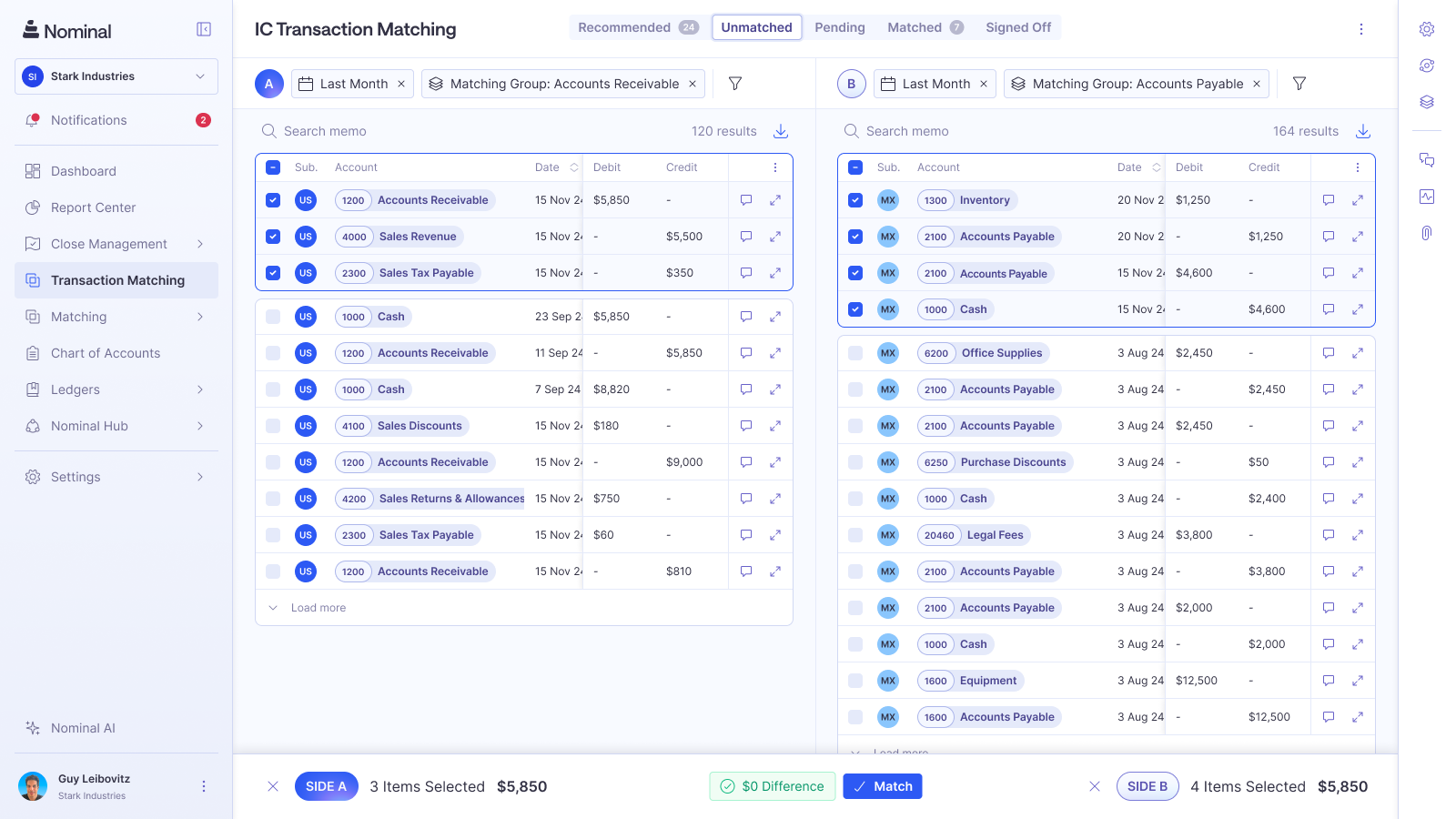
Matching agents scan intercompany accounts across all entities and identify corresponding transactions. They handle timing differences, currency conversions, and reference mismatches. Once matched and signed off, the elimination agent posts the consolidation entry automatically.
AR/AP Matching
Accounts receivable and payable matching involves reconciling invoices to payments. A customer might pay multiple invoices with a single wire or short-pay due to a dispute.
Matching agents compare invoice and payment records at the transaction level, apply fuzzy logic to account for reference errors, and categorize exceptions. They can match one payment to many invoices or complex netting scenarios.
The Role of Matching Agents in Modern Finance Operations
Matching agents fundamentally change how finance teams operate by shifting reconciliation from a manual, period-end scramble to an automated, continuous process.
From manual review to exception management
Rather than comparing thousands of transactions line by line, teams focus exclusively on discrepancies that require human judgment. Nominal performs over 90% of reconciliation matches automatically, leaving finance professionals to review only the exceptions that genuinely need attention.
From period-end to continuous reconciliation
Traditional processes treat reconciliation as a monthly event that delays close. Matching agents process transactions as they occur, maintaining an always-current view of account balances. This eliminates the scramble and provides real-time visibility into discrepancies.
From audit prep to audit-ready state
Every match, exception, and resolution is logged with full context and traceability. When auditors request support, the documentation already exists. This reduces prep time and strengthens controls without additional manual effort.
The results are measurable
One enterprise customer reduced manual matching from 150,000 lines per month to reviewing just 10% of the data, eliminating 90% of manual effort while closing faster. Another automated matching across 30 entities, transforming manual, entity-by-entity reconciliation into continuous, audit-ready matching that requires no preparation when auditors arrive.
This shift is possible because matching agents operate within a closed-loop platform that combines a native general ledger, task management, and AI agents. The ledger provides transaction-level visibility. Task management ensures oversight and collaboration. Agents execute the work autonomously. Together, these three components create a system where matching, resolution, and posting happen seamlessly without manual intervention.
Matching agents represent a fundamental shift in reconciliation. They bring intelligent execution, continuous processing, and audit-ready traceability to close processes.
For finance leaders managing multi-entity operations and high transaction volumes, matching agents are foundational.
Ready to see how matching agents can transform your reconciliation process? Book a demo to see Nominal in action.