


AI agents in finance and accounting execute real tasks autonomously, handling reconciliations, variance analysis, and transaction matching. Unlike traditional automation or AI assistants, these agents reason through problems, adapt to exceptions, and work alongside finance teams to eliminate manual work while maintaining full oversight and audit readiness.
Finance teams today face mounting pressure from every direction. Multi-entity operations grow more complex. Close deadlines shrink. Audit requirements expand. Meanwhile, the accounting talent pool continues to contract, with 75% of CPAs set to retire within 15 years.
Traditional tools have reached their limits. ERPs store data but rarely interpret it. Rules-based automation handles repetitive tasks but breaks when exceptions occur. Even AI assistants that answer questions still leave the actual work to humans.
AI agents represent an evolution: systems that don't just suggest or assist, but actually execute work with autonomy and intelligence. They reconcile transactions, detect errors before close, generate contextual analysis, and handle the manual workload that has kept finance teams stuck in reactive mode.
Organizations using AI agents are closing faster, reducing errors, and reallocating capacity toward strategic work. This isn't about replacing finance professionals. It's about freeing them from repetitive execution so they can focus on judgment, analysis, and decision-making.
What Is an AI Agent?
AI agents are autonomous systems designed to achieve specific goals through reasoning and action. Unlike traditional automation that follows rigid if-then rules, agents can interpret context, make decisions, and adapt their approach when conditions change.
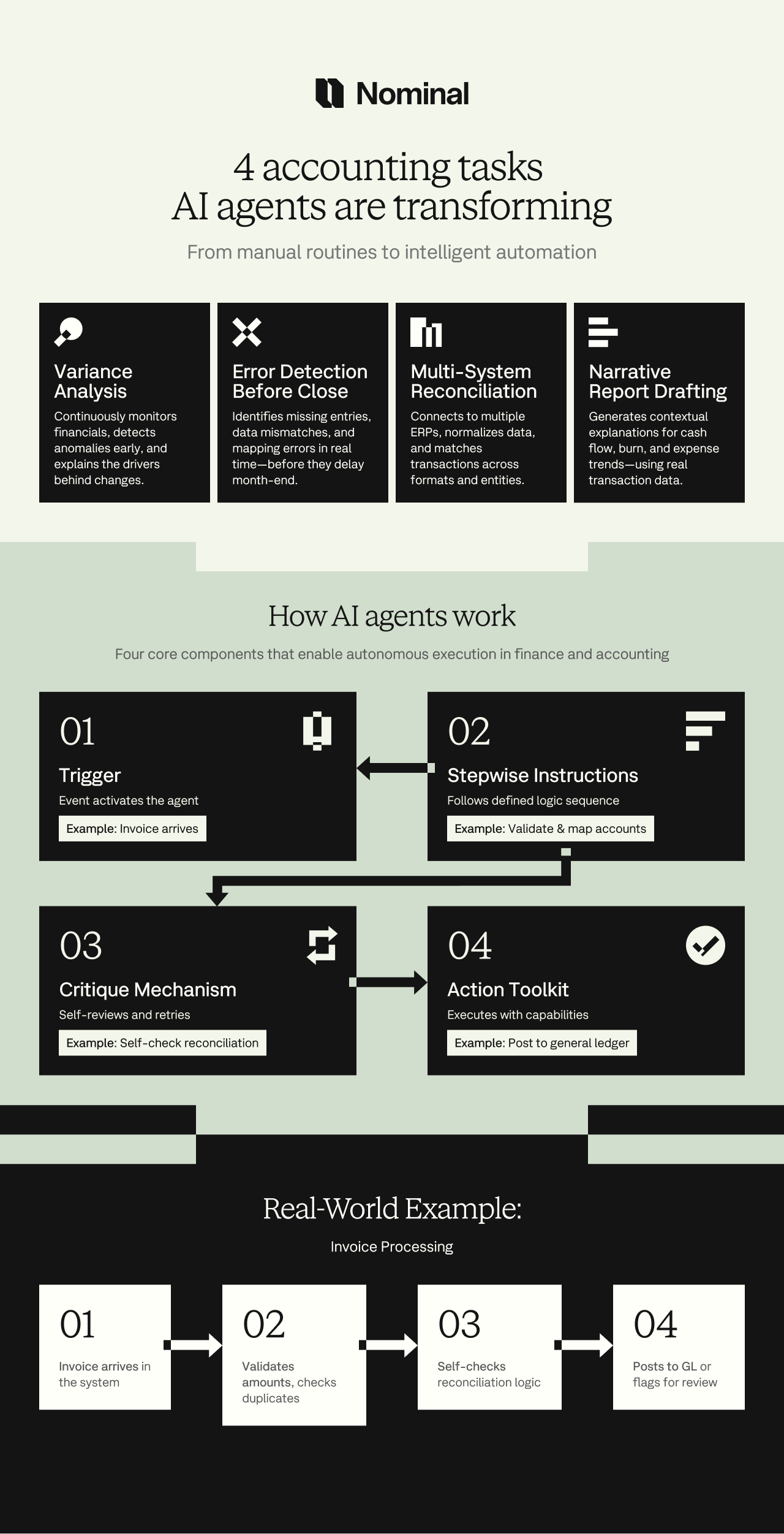
The agentic model operates through four core components. Triggers activate the agent when defined events occur. Stepwise instructions mirror how a finance professional would approach the task. A critique mechanism allows the agent to review its own work and retry when something doesn't reconcile. Action toolkits give the agent specific capabilities, like connecting to a general ledger or matching transactions.
This architecture creates systems that handle end-to-end workflows rather than isolated steps. When an invoice arrives, an agent doesn't just extract data. It validates amounts, checks for duplicates, maps to the correct accounts, and flags discrepancies for review.
Why AI Agents Matter in Enterprise Finance
Finance environments are dynamic and data sits fragmented across systems. Subsidiaries operate in different ERPs. Transactions flow through multiple subledgers. Currency conversions add complexity. Manual processes can't keep pace with this reality.
Agents enable scalable workflows because they work across these fragmented systems without requiring data migration or process standardization. They sit on top of existing ERP infrastructure, pulling transaction-level detail and operating where the work actually happens.
This approach allows organizations to scale revenue without proportionally scaling headcount because agents absorb the manual workload that typically expands with growth.
Keep reading: Modern Accounting Tools: Excel vs RPA vs AI Agents Compared
Key Use Cases of AI Agents in Finance and Accounting
The power of AI agents becomes clear when examining how they transform specific finance workflows. These applications demonstrate how autonomous execution combined with financial intelligence eliminates bottlenecks that have constrained teams for years.
AI-Powered Variance Analysis at Scale
Traditional variance analysis happens after close, when finance teams compare actuals to budget and scramble to explain unexpected fluctuations. Agents flip this model by monitoring financials continuously across entities, accounts, and periods.
These systems detect anomalies early by recognizing patterns in transaction behavior. When prepaid expenses drop while operating expenses rise, the agent connects those movements and identifies the likely driver. When revenue spikes in one subsidiary but not others, it surfaces the context behind that divergence.
More importantly, agents don't just flag variances. They generate explanations by analyzing transaction details, vendor activity, contract changes, and historical patterns. Accounting teams receive contextual narratives ready for review rather than starting from a blank spreadsheet.
This removes the need for reactive variance analysis during the most stressful part of close. Teams can address issues as they emerge instead of discovering them under deadline pressure.
Smarter Error Detection Before Month-End
Most finance systems identify errors after they cause problems. An account doesn't reconcile. Eliminations don't balance. By that point, teams face tight deadlines and limited options.
Agents work proactively throughout the period. They monitor transaction flows, identify missing entries, catch inconsistent account mappings, and spot data gaps before the close begins.
When an intercompany transaction records on one side but not the other, the agent triggers an alert immediately. When vendor invoices don't match purchase orders, the system surfaces the discrepancy with suggested resolutions. These interventions shift month-end from detective work to finalization.
You might also like: What Is Month-End Flux? How Finance Teams Analyze Variances Faster
AI Agents for Multi-System Reconciliation
Accounting teams managing multiple entities often face reconciliation challenges across systems. Each subsidiary operates its own GL. Transactions flow through different subledgers. Bank feeds arrive in various formats.
Agents handle this complexity by reconciling data across fragmented systems continuously. They connect to multiple ERPs, normalize chart of accounts automatically, and match transactions regardless of format differences or timing gaps.
The matching logic goes beyond simple amount comparison. Agents account for currency conversions, recognize transaction patterns, and identify intercompany transactions even when not explicitly tagged by learning organizational hierarchies and transaction behaviors.
When discrepancies appear, agents suggest elimination entries, propose adjustments, and prepare documentation. This automation accelerates intercompany close across complex entity structures.
Bringing Business Context Into Financial Reports
Controllers spend significant time translating financial movements into narratives that stakeholders can understand. Cash flow decreased, but why? Operating expenses rose, but from what activities?
Narrative agents generate contextual explanations based on actual financial data. They analyze transaction-level movements and connect them to business events. When cash burn accelerates, the agent explains whether the driver was vendor timing, payroll increases, or capital expenditures.
These systems pull in data from adjacent platforms like CRM and payroll to enhance storytelling. If revenue grows in one segment, the agent references new customer acquisitions. If labor costs rise, it connects that movement to headcount changes.
The result is decision-ready reporting without starting from scratch. Finance teams receive draft commentary they can refine rather than blank documents they must populate manually.
Not all "AI automation" is agentic. Most rules-based bots can't reason or self-adapt. AI agents are different: they act with autonomy toward a financial goal.
Examples of AI Agents in Real Financial Operations
Concrete examples help clarify how agents work in actual finance operations.
An agent reconciles AP ledgers daily across five ERPs. It ingests data from NetSuite, QuickBooks, and SAP simultaneously, normalizes account codes, matches vendor invoices to payment records, and flags discrepancies when amounts don't align. The finance team reviews only the exceptions.
Another agent drafts cash burn summaries for FP&A every Monday. It analyzes the previous week's transactions, calculates net cash movement, identifies the largest outflows by category, and generates a narrative explaining changes compared to the prior week.
A third agent flags missing invoices before monthly close. It monitors purchase orders, cross-references received goods, and identifies when inventory has been received, but no corresponding invoice appears in the system. Finance can contact vendors proactively rather than discovering the gap during close.
Human Oversight and Controls
The shift toward agentic automation redefines finance roles from execution to oversight. Agents handle repeatable workflows that follow consistent logic. Humans provide judgment on exceptions, strategic interpretation, and approval authority.
Every action an agent takes generates a reviewable task. When an agent suggests an elimination entry, it doesn't post automatically. The entry appears in a queue with full documentation showing the matching logic, source transactions, and recommended accounting treatment. A controller reviews and approves before the entry hits the general ledger.
Finance teams configure approval thresholds, define materiality levels, and set rules for when human review is required. The system respects these boundaries while handling everything below those thresholds automatically.
Audit trails are essential to this model. Agents log every step they take, creating documentation that shows what was analyzed, what logic was applied, and what conclusions were reached. This transparency supports both internal controls and external audits.
Explore more on this topic: AI in Audit: Automating Reconciliations and Financial Reporting
Choosing the Right Finance AI Partner
Not all platforms claiming to offer AI agents actually deliver agentic capabilities. Many provide AI-assisted features that still require significant manual work. Others offer generic automation that doesn't understand finance-specific logic.
The platform should integrate seamlessly with your existing ERP without forcing a migration. It should support compliance requirements through SOC certifications and clear data processing agreements. And it should scale across entities, currencies, and accounting complexity.
The critical differentiator is whether the platform provides true agentic automation with financial context. Generic AI tools don't understand intercompany eliminations, revenue recognition rules, or consolidation requirements.
Nominal combines three elements that work together. A general ledger operates at the transaction level, providing the granular data agents need to reason effectively. Task management provides oversight, ensuring agents operate within defined controls. And the agents themselves execute the automated work, creating a closed-loop system where insights lead to actions that generate results.
AI agents represent a fundamental shift in how financial operations can function. By combining autonomous execution with financial intelligence, these systems eliminate the manual burden that has constrained finance professionals for decades.
Organizations implementing agents today are closing faster, detecting issues earlier, and reallocating capacity toward strategic analysis. They're proving that controllers don't need to choose between speed and control.
As complexity continues to grow and talent becomes scarcer, this technology moves from a competitive advantage to an operational necessity. The question is no longer whether to adopt AI agents but how quickly organizations can implement them effectively.
See how AI agents can automate your financial close. Explore Nominal's agentic automation platform and discover how transaction-level intelligence, task-based oversight, and intelligent agents work together to transform finance operations. Book a demo today.